
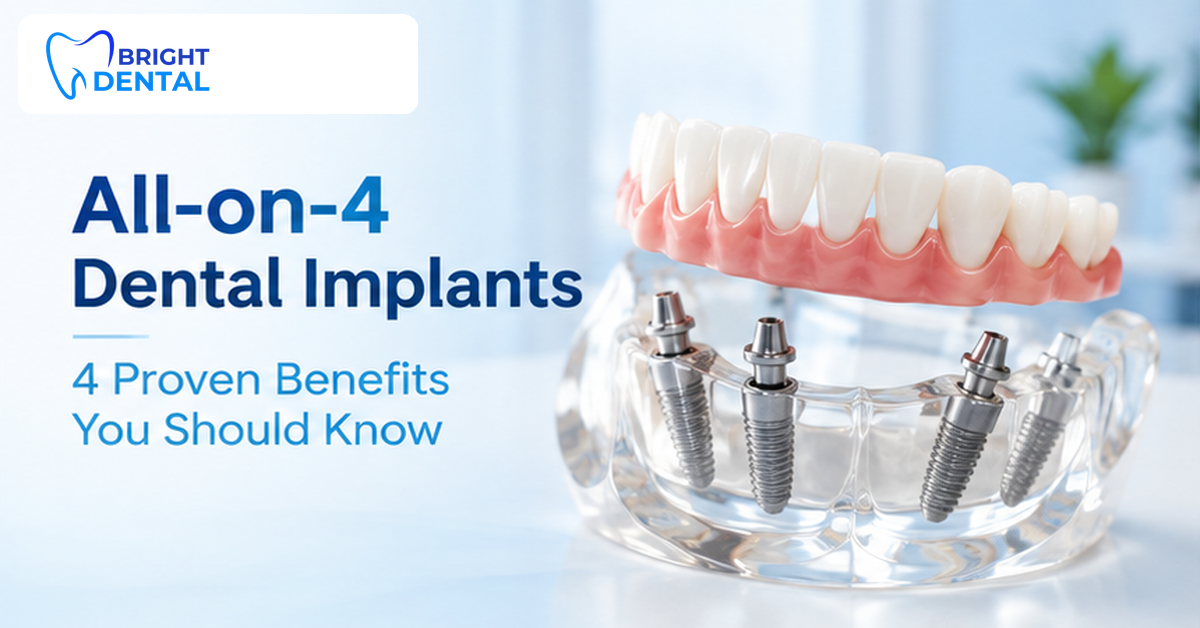

Losing most or all of your teeth does not mean settling for loose, uncomfortable dentures. All-on-4 dental implants offer a fixed, full-arch solution that restores your bite and your smile in far less time than traditional implant methods. In this guide from Bright Dental, you will learn how this treatment works, its proven benefits, what the procedure involves, and whether you are a good candidate.

Quick answer: The All-on-4 dental implants is a full-arch tooth replacement method that uses just four strategically placed implants to support an entire row of fixed replacement teeth, often in a single day.
What Is the All-on-4 Technique?
The All-on-4 dental implants technique replaces a full arch of missing or failing teeth using only four implants instead of one implant per tooth. The implants are placed at specific angles that take advantage of the strongest areas of the jawbone, which often means patients can avoid bone grafting even when some bone loss has occurred.
Once the four implants are placed, a fixed bridge of replacement teeth is attached on top. Unlike removable dentures, this bridge does not come out, click, or shift while eating or speaking.
4 Proven Benefits of This Treatment
The All-on-4 dental implants gives you 4 proven benefits are following:
- Fewer implants needed: Only four implants support a full arch, compared to the six or more used in some other full-arch methods.
- Faster treatment: Many patients receive a temporary fixed set of teeth on the same day as surgery, avoiding months without teeth.
- Less need for bone grafting: The angled placement uses denser areas of the jaw, which often makes a separate grafting procedure unnecessary.
- Stable, natural function: Because the bridge is fixed in place, patients can chew, speak, and smile with confidence, without the slipping associated with dentures.
Who Is a Good Candidate?
The All-on-4 dental implants is often recommended for patients who:
- Are missing most or all of their teeth in one or both arches
- Wear dentures that feel loose, uncomfortable, or unstable
- Have some jawbone loss but want to avoid extensive grafting
- Want a fixed, non-removable solution rather than a removable denture
- Are in good general health and do not have uncontrolled conditions that affect healing
A dental exam, including X-rays or a 3D scan, confirms whether this treatment is the right fit for your jaw structure and health.
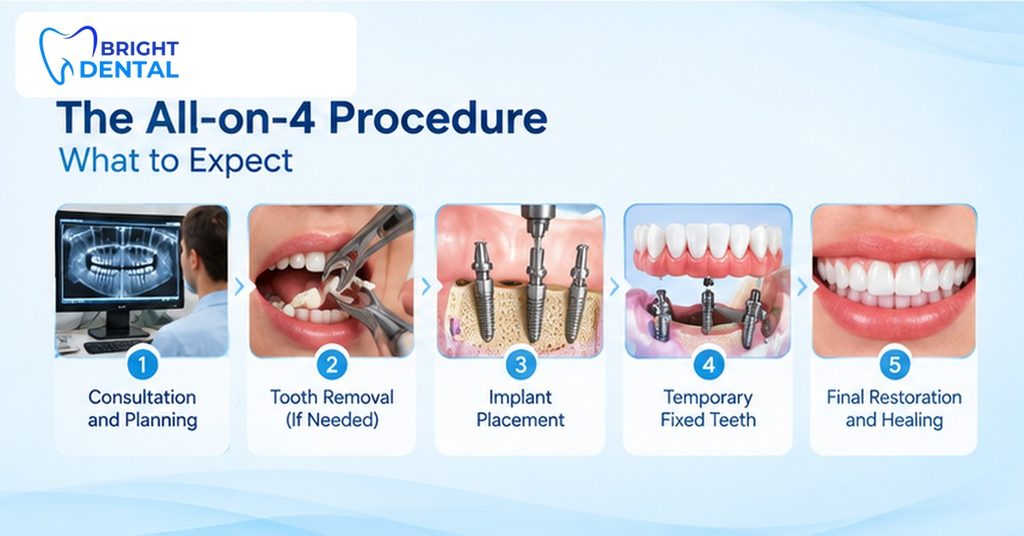
The Procedure: What to Expect
1. Consultation and Planning
Your dentist examines your mouth, reviews imaging, and creates a treatment plan tailored to your bite and bone structure.
2. Tooth Removal (If Needed)
Any remaining damaged or failing teeth in the arch are removed, often during the same visit as implant placement.
3. Implant Placement
Four implants are positioned at precise angles in the jawbone under anesthesia.
4. Temporary Fixed Teeth
A temporary bridge is often attached the same day, so you do not leave without teeth while healing occurs.
5. Healing and Final Restoration
Over the following months, the implants fuse with the bone. Once healing is complete, a final, custom-made bridge replaces the temporary one.
Recovery and Aftercare
Mild swelling, soreness, or bruising in the first few days is normal and manageable with medication your dentist recommends.
Simple aftercare tips:
- Stick to soft foods during the initial healing period
- Avoid smoking, which slows healing
- Keep the surgical area clean as instructed
- Attend all follow-up visits so your dentist can monitor healing
- Once your All-on-4 dental implants bridge is fully healed, brush and clean around it daily
All-on-4 vs. Traditional Dentures
| Feature | All-on-4 | Traditional dentures |
|---|---|---|
| Stability | Fixed in place | Can shift or slip |
| Chewing ability | Close to natural teeth | Reduced biting force |
| Daily care | Brush like natural teeth | Remove and soak nightly |
| Bone preservation | Implants stimulate the jawbone | Bone loss continues over time |
| Treatment time | Often completed in one day | Faster to make, but less stable long term |

Frequently Asked Questions
Is the All-on-4 dental implants procedure painful?
The All-on-4 dental implants surgery is done under anesthesia, so you should not feel pain during placement. Some soreness afterward is normal and manageable.
How long do All-on-4 dental implants last?
With good oral hygiene and regular checkups, your All-on-4 dental implants can last decades, while the bridge on top may need replacement or adjustment after many years of use.
Can I eat normally afterward?
Most patients return to a soft diet initially, then gradually resume a normal diet as healing progresses and the final bridge is placed.
Do I need bone grafting first?
Often not, since the angled implant placement uses the densest parts of the jaw. Your dentist will confirm this after an exam.
Looking for All-on-4 Dental Implants in Des Plaines?
Bright Dental proudly serves patients from Des Plaines and offers dental implants near Mount Prospect as well. If you are tired of loose dentures or missing teeth and want a fixed, long-term solution, our team can walk you through every step of the All-on-4 process.
Conclusion
All-on-4 dental implants offer a faster, more stable way to replace a full arch of missing teeth compared to traditional dentures. With fewer implants, less need for bone grafting, and often same-day temporary teeth, this treatment helps patients regain confidence in their bite and their smile.
Looking for All-on-4 Dental Implants Near You?
Bright Dental serves patients in Des Plaines, Mount Prospect, and Arlington Heights. Contact our team to explore your All-on-4 dental implant options.
