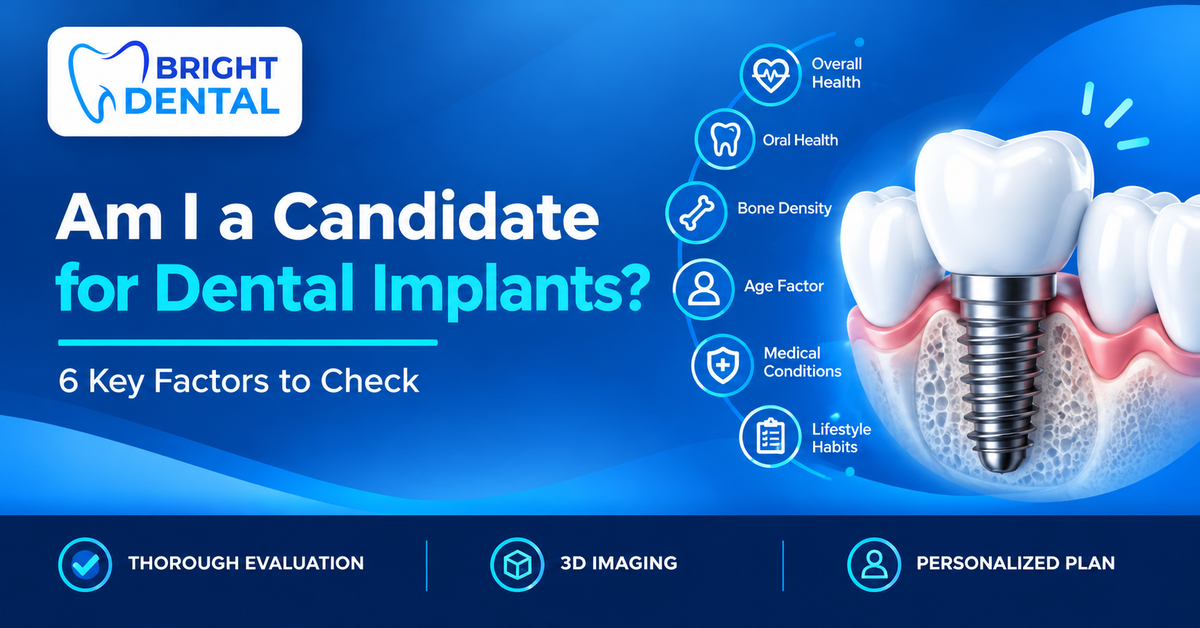

If you are missing one or more teeth, you have probably wondered whether you are a candidate for dental implants. The good news is that most healthy adults qualify, but a few specific factors determine whether implants are the right fit for your mouth. In this guide from Bright Dental, you will learn the six main factors your dentist checks, along with health conditions and habits that can affect your candidacy.
Quick answer: Most adults with healthy gums, enough jawbone, and no uncontrolled medical conditions are good candidates for dental implants. A dental exam with imaging is the only way to confirm your exact candidacy.
Why Candidacy Matters Before Treatment
Before treatment begins, your dentist evaluates whether you are a candidate for dental implants, since implants are surgically placed into the jawbone and your dentist needs to confirm that your bone, gums, and overall health can support the procedure and long-term healing. Skipping this step can lead to complications or implant failure, which is why a thorough evaluation always comes first.
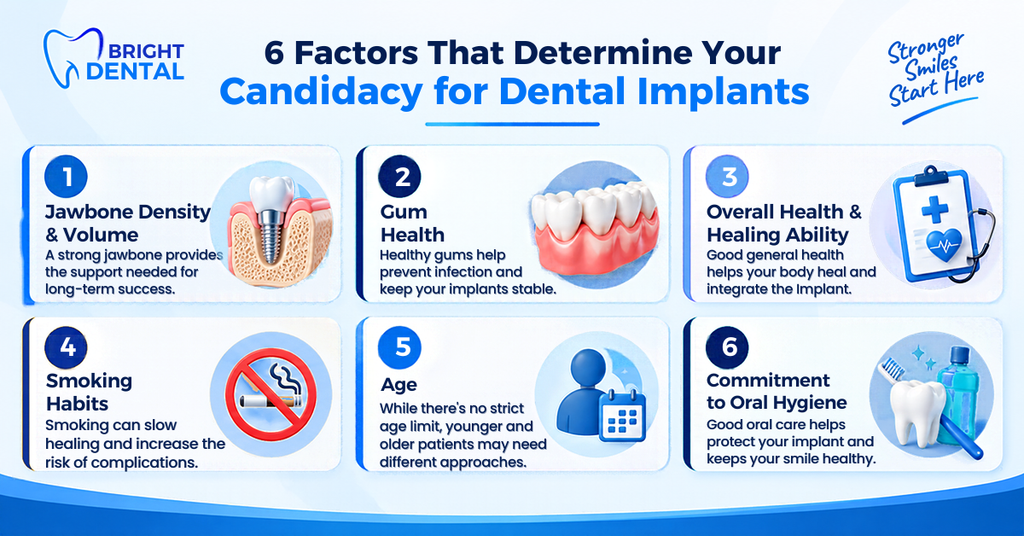
6 Key Factors That Determine If You Are a Candidate for Dental Implants
1. Jawbone Density and Volume
Implants need enough bone to anchor into securely. Patients who have lost bone from years without a tooth root may still qualify, often with a bone graft performed before or during implant placement. If you have been wearing dentures for years, learn more about dental implants after dentures and how your dentist can evaluate your jawbone and treatment options.
2. Gum Health
Active gum disease can affect healing and implant stability. Most dentists recommend treating gum disease first, after which many patients become excellent candidates.
3. Overall Health and Healing Ability
Conditions that slow healing, such as uncontrolled diabetes, can affect the outcome. Well-managed health conditions usually do not rule out treatment, but your dentist will want your condition stable before moving forward.If you have diabetes, read our guide to dental implants with diabetes to learn more about the factors your dentist may consider before treatment.
4. Smoking Habits
Smoking slows healing and increases the risk of implant failure, which is a major factor in whether you are a candidate for dental implants. Many dentists recommend quitting, or at least pausing, around the time of surgery to improve your odds of success.
5. Age
There is no strict upper age limit for implants, as long as you are in reasonably good health. For younger patients, dentists typically wait until the jaw has finished growing, usually by the late teens.
6. Commitment to Oral Hygiene
Because implants rely on healthy surrounding gum tissue, patients need to commit to daily brushing, flossing, and regular dental visits to keep them healthy long term.
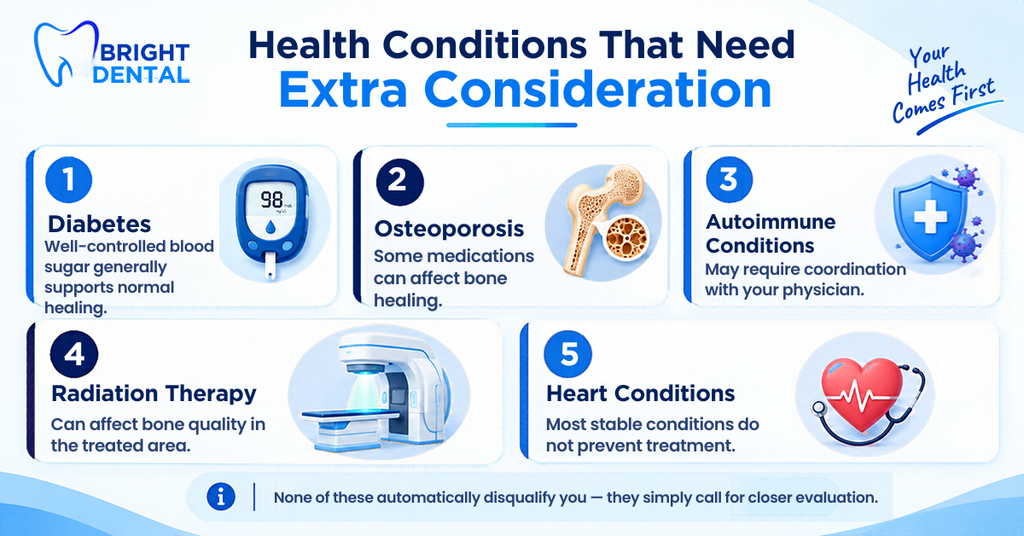
Health Conditions That Need Extra Consideration
Some conditions do not automatically disqualify a patient, but they do call for closer evaluation and sometimes a modified plan:
- Diabetes: well-controlled blood sugar levels generally support normal healing
- Osteoporosis: some medications used for this condition can affect bone healing, so your dentist will review your prescriptions
- Autoimmune conditions: these can sometimes affect healing and require coordination with your physician
- Radiation therapy to the head or neck: this can affect bone quality in the treated area
- Heart conditions: most stable heart conditions do not prevent treatment, but your dentist may consult your cardiologist for complex cases
None of these conditions mean you are automatically excluded. They simply mean your treatment plan may need extra coordination between your dentist and your physician.
Who Is Generally NOT a Good Candidate for Dental Implants?
While most patients qualify, implants may not be recommended, or may need to be delayed, for patients who:
- Have severe, unmanaged gum disease
- Have very low bone volume and decline bone grafting
- Smoke heavily and are unwilling to reduce or pause smoking around surgery
- Have poorly controlled diabetes or another unmanaged chronic condition
- Are still growing, in the case of teenage patients
Many of these situations are temporary rather than permanent. Treating gum disease, stabilizing a health condition, or completing a bone graft can often open the door to implants later.
How Your Dentist Confirms Candidacy
1. Comprehensive Oral Exam
Your dentist checks your gum health, remaining teeth, and bite. Learn more about the different dental implant treatment options available at Bright Dental.
2. Dental X-Rays or a 3D Scan
Imaging reveals your bone density and volume, along with the position of nerves and sinus cavities, confirming whether you are a candidate for dental implants.
3. Medical History Review
Your dentist reviews your health conditions, medications, and habits like smoking, since these all factor into whether you are a candidate for dental implants. You can also read general guidance on dental implants from the ADA’s MouthHealthy resource.
4. Treatment Planning Discussion
If you are a candidate, your dentist outlines the implant type, number needed, and whether any preparatory procedures like a bone graft are required.
What If You Are Not an Ideal Candidate Yet?
Being told you are not yet a candidate for dental implants does not mean implants are off the table permanently. Common next steps include:
- A bone graft or sinus lift to build up bone volume
- Treating active gum disease before moving forward
- Working with your physician to stabilize a health condition
- Reducing or quitting smoking ahead of surgery
Once these steps are complete, many patients who were not initially candidates become strong candidates for treatment.
Frequently Asked Questions
Can I get dental implants if I have diabetes?
Many patients with well-controlled diabetes are good candidates for dental implants, since diabetes alone rarely rules out being a candidate for dental implants. Your dentist will want your blood sugar levels stable before and after surgery.
Is there an age limit for dental implants?
There is no strict upper age limit, as long as you are in good general health. Dentists typically wait until a patient’s jaw has finished growing before placing implants.
Can smokers get dental implants?
Yes, though smoking increases the risk of complications. Many dentists recommend reducing or pausing smoking around the time of surgery to support healing.
What if I do not have enough jawbone?
A bone graft or sinus lift can often build up the bone needed, making many patients who initially lack sufficient volume into good candidates later.
Conclusion
Most healthy adults are candidates for dental implants, even those who need a bone graft, have a managed health condition, or smoke, since being a candidate for dental implants depends on several factors working together. The only way to know for certain is a comprehensive exam with imaging, which allows your dentist to evaluate your bone, gums, and overall health together.
Ready to find out if you are a candidate for dental implants? Book a consultation at Bright Dental, and our team will walk you through a complete evaluation.
Looking to Find Out if You Are a Candidate for Dental Implants Near Glencoe, Vernon Hills, or Bannockburn?
Bright Dental proudly serves patients from Des Plaines, Mount Prospect, Glencoe, Vernon Hills, and Bannockburn. Our team offers a thorough evaluation and imaging to confirm whether you are a candidate for dental implants and outline a personalized treatment plan.
