
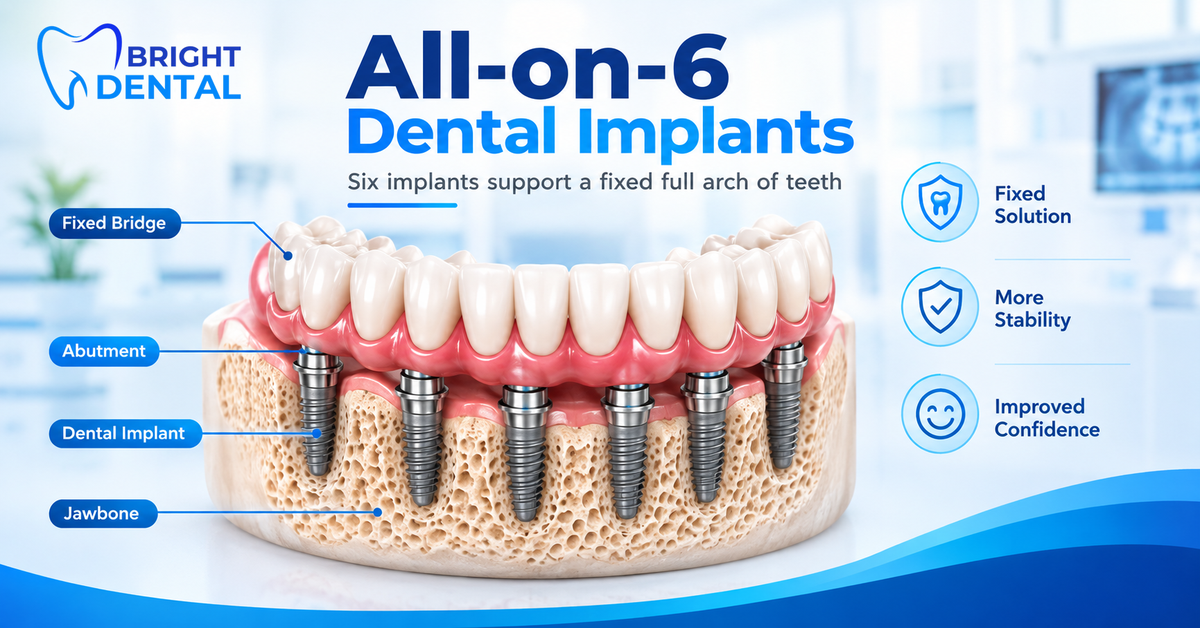

Missing most or all of your teeth can make everyday activities like eating, speaking, and smiling more difficult. All-on-6 dental implants offer a fixed full-arch treatment option that uses six strategically placed implants to support a custom replacement arch of teeth. Unlike a traditional removable denture, the restoration is anchored to dental implants for greater stability.
In this guide from Bright Dental, you will learn how All-on-6 dental implants work, who may benefit from them, how they compare with All-on-4 treatment, and what to expect during the treatment process.
Quick Answer: All-on-6 dental implants use six strategically placed dental implants to support a fixed full arch of replacement teeth. The number and placement of implants depend on your bone structure, bite, oral health, and individual treatment plan.
What Are All-on-6 Dental Implants?
All-on-6 dental implants are a full-arch tooth replacement approach for patients who are missing most or all of the teeth in one arch. Instead of replacing every missing tooth with an individual implant, six implants can be strategically positioned in the jaw to support a complete fixed bridge.
The implants act as artificial tooth roots. After they integrate with the surrounding bone, they can provide a stable foundation for a custom-made restoration.
At Bright Dental, full arch dental implants can be planned with four or more strategically placed implants to replace an entire upper or lower arch, depending on each patient’s needs.
Fact 1: Six Implants Can Provide Additional Support
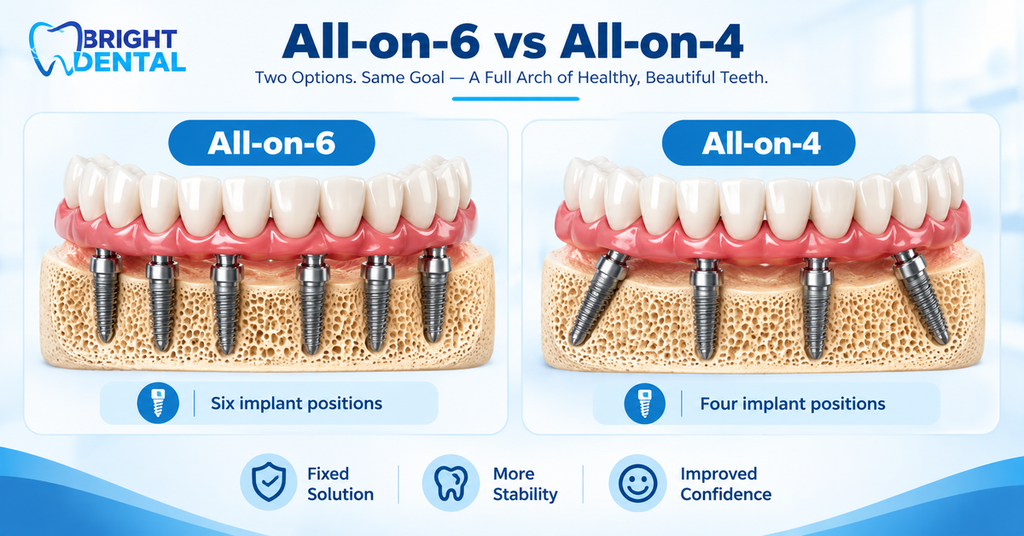
One of the main differences between All-on-6 and All-on-4 treatment is the number of implants supporting the restoration.
With All-on-6 implants, six implants are used to distribute the support for the full-arch restoration across the available jawbone. This may be beneficial for some patients because additional implants can provide another point of support for the fixed bridge.
However, more implants do not automatically mean that All-on-6 is better for every patient.
Your dentist needs to consider:
- Available bone volume and density
- The shape and anatomy of your jaw
- Your bite and chewing forces
- Gum and oral health
- The condition of any remaining teeth
- Your overall treatment goals
A 3D scan and comprehensive dental examination help determine whether six implants are appropriate for your case.
Fact 2: All-on-6 Can Replace an Entire Arch
All-on-6 full arch dental implants are designed for full-arch restoration rather than replacing just one or two missing teeth.
Depending on your treatment plan, the approach can be used to restore:
- A complete upper arch
- A complete lower arch
- An arch with several failing or severely damaged teeth
- An arch where traditional removable dentures are no longer providing the desired stability
The final restoration is custom-designed to fit your mouth, bite, facial structure, and smile.
This makes All-on-6 different from a single tooth implant, which replaces one missing tooth with an implant, abutment, and crown. You can learn more about single-tooth options on our Dental Implants page.
It is also different from an implant-supported overdenture because a fixed full-arch bridge is designed to remain attached to the implants rather than being removed by the patient for routine daily use.
Fact 3: Treatment Requires Careful Planning
A successful full-arch implant treatment begins long before the implants are placed.
During your consultation, your dentist may evaluate:
Jawbone Structure and Digital Imaging
The available bone must be assessed to determine where implants can be placed safely and predictably. 3D imaging, such as a CBCT scan, can help your dentist evaluate the jawbone and plan implant positions.
Bite and Jaw Relationship
Your bite affects how forces are distributed across the final restoration. Your dentist needs to plan the implants and replacement teeth together rather than treating them as separate steps.
Gum and Oral Health
Active gum disease, infection, or other oral health problems may need to be addressed before implant placement.
Because every patient has different anatomy, All-on-6 dental implants are not placed using exactly the same positions or angles for everyone.
Fact 4: All-on-6 vs All-on-4 Is Not a Simple “Better or Worse” Choice
Patients often ask whether All-on-6 is better than All-on-4. The answer depends on the individual patient.
Both approaches are designed to support a full arch with strategically placed implants. The main difference is the number of implants used.
| Feature | All-on-6 | All-on-4 |
|---|---|---|
| Implants used | Six | Four |
| Support points | Six implant positions | Four implant positions |
| Best for | Patients whose bone and bite make six implants suitable | Patients whose bone and bite make four implants suitable |
Some patients may benefit from the additional support provided by six implants, while others may achieve an appropriate result with four.
All-on-6 dental implants should therefore be viewed as one treatment option rather than automatically being considered superior to All-on-4. Your dentist can recommend the appropriate approach after reviewing your bone structure, bite, oral health, and restoration needs.
Fact 5: Recovery and Final Results Take Time
The treatment process for All-on-6 dental implants happens in stages.
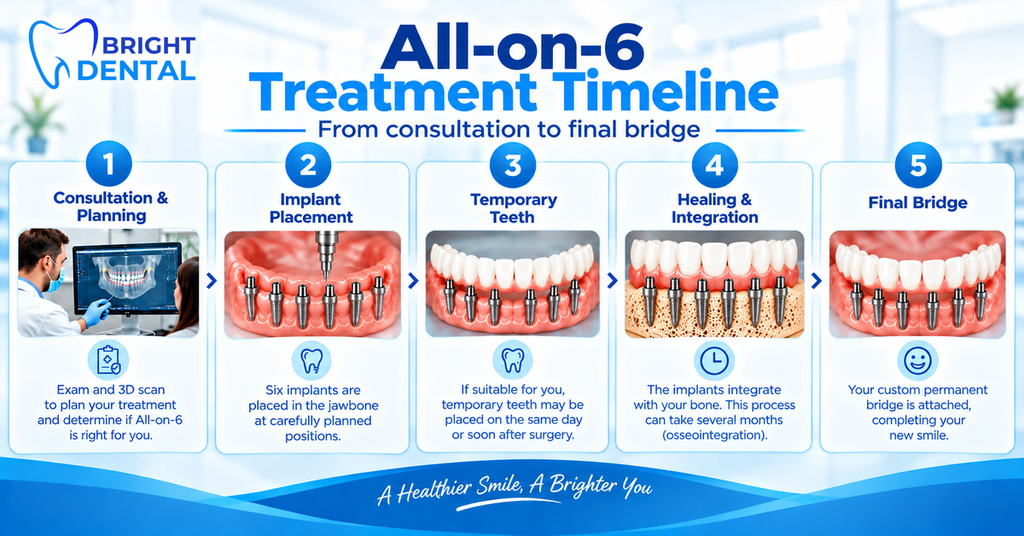
1. Consultation and Planning
Your dentist evaluates your oral health, jawbone, bite, and treatment goals. Digital imaging may be used to create a detailed implant plan.
2. Implant Placement
The six implants are surgically placed in carefully selected areas of the jawbone.
3. Temporary Restoration
Some patients may receive temporary fixed teeth on the same day or shortly after implant placement. Whether immediate teeth are possible depends on factors such as implant stability, bone quality, and your individual treatment plan.
4. Healing and Implant Integration
The implants need time to integrate with the surrounding bone. This process, called osseointegration, can take several months.
5. Final Restoration
Once your dentist confirms that healing and implant stability are satisfactory, the temporary restoration can be replaced with a custom permanent bridge.
Your exact timeline can vary based on your bone condition, whether additional procedures are required, and how your body heals.
Who May Be a Candidate for All-on-6?
All-on-6 dental implants may be considered for patients who:
- Are missing most or all teeth in one arch
- Have multiple failing or severely damaged teeth
- Want a fixed alternative to a removable denture
- Have adequate bone for implant placement or can undergo appropriate preparation
- Have suitable oral and general health for implant treatment
- Are committed to maintaining good oral hygiene and regular dental visits
However, having missing teeth alone does not automatically make someone a candidate. A comprehensive dental examination and 3D imaging are needed to determine whether this treatment is appropriate.
What Can Affect the Cost of All-on-6 Dental Implants?
The All-on-6 dental implants cost varies from patient to patient because full-arch treatment involves more than simply placing six implants.
Factors that can affect treatment cost include:
- Number and type of implants
- Type of final restoration
- Need for tooth extractions
- Bone grafting or other preparatory procedures
- Diagnostic imaging and treatment planning
- Temporary restoration
- Materials used for the final bridge
- Individual oral health needs
For this reason, an in-person consultation is the best way to receive a treatment plan and personalized cost estimate.
All-on-6 vs. Traditional Dentures
Traditional dentures are removable and rest on the gums. They can be an effective option for some patients, but they may move during chewing or speaking.
All-on-6 dental implants are anchored to implants placed in the jawbone and support a fixed restoration.
| Feature | All-on-6 | Traditional Denture |
|---|---|---|
| Stability | Fixed to implants | Removable |
| Support | Dental implants | Gums and oral tissues |
| Removal | Not routinely removed by the patient | Removed for cleaning |
| Chewing stability | Generally greater than conventional dentures | Can vary depending on fit |
| Bone support | Implants can help preserve bone around implant sites | Bone loss may continue after tooth loss |
The right choice depends on your oral health, anatomy, preferences, and treatment goals.
Frequently Asked Questions
Are All-on-6 dental implants permanent?
The implants are designed as a long-term tooth replacement solution. However, the implant-supported restoration may require maintenance or replacement over time because materials experience normal wear.
Are six implants always necessary?
No. The number of implants needed depends on your anatomy and treatment plan. Some full-arch patients may be suitable for four implants, while others may benefit from additional implants.
Can All-on-6 replace upper and lower teeth?
Yes, full-arch implant treatment can be planned for either the upper or lower arch. Treating both arches may also be possible for selected patients.
Can I get temporary teeth on the same day?
Some patients can receive temporary fixed teeth on the day of implant placement, but this is not appropriate for everyone. Your dentist will determine whether immediate loading is suitable based on implant stability and other clinical factors.
How do I know if All-on-6 is right for me?
A dental examination, 3D imaging, and treatment consultation are needed to determine whether six implants are appropriate for your jaw structure, oral health, bite, and goals.
Conclusion
All-on-6 dental implants can give you a fixed full-arch solution if you are missing most or all of your teeth. Six implants provide multiple support points for a custom bridge.
Still, All-on-6 is not right for every patient. Your bone, bite, oral health, remaining teeth, and goals all shape the best plan. A consultation and 3D evaluation can show whether All-on-6, All-on-4, or another option fits you best.
Looking for All-on-6 Dental Implants Near Buffalo Grove?
Bright Dental proudly serves patients from Buffalo Grove, Wilmette, and Winnetka. If you are missing most or all of your teeth and are considering a fixed full-arch solution, our dental team can evaluate your oral health and jaw structure and help you understand whether All-on-6 dental implants are right for you.
