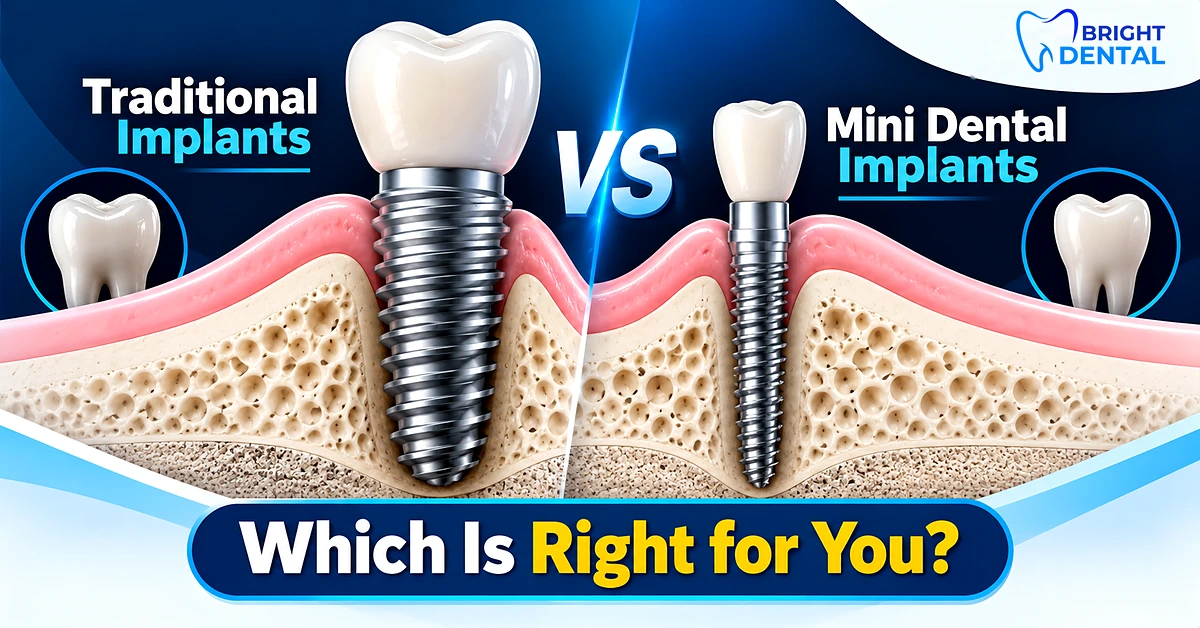

Missing teeth can affect your confidence, chewing ability, and oral health. Dental implants offer a reliable way to replace missing teeth, but choosing the right option requires careful consideration.
Understanding mini dental implants vs traditional implants can help you compare their size, benefits, costs, recovery, and long-term performance.
This guide explains seven important differences to help you make an informed decision with your dentist.
Quick Answer: Mini Dental Implants vs Traditional Implants
Mini dental implants are narrower implants often used to stabilize dentures or support selected restorations. Traditional dental implants are generally wider and can support crowns, bridges, and implant-retained dentures.
Neither option is best for everyone. Your jawbone health, treatment goals, and oral condition determine which approach is suitable. Choosing between mini dental implants vs traditional implants requires evaluating the benefits, limitations, and long-term treatment goals.
What Are Mini Dental Implants?
Mini dental implants are narrow implants, often around 3 mm or less in diameter.
Their smaller size may make them suitable for patients with limited jawbone width. They are commonly considered for certain denture-stabilization treatments.
Mini dental implants also have selected restorative applications, and the suitability of either implant option depends on an individual’s oral health, bone condition, and treatment needs.
Some designs combine the implant and attachment into one piece.
However, mini implants are not appropriate for every tooth replacement.
What Are Traditional Dental Implants?
Traditional dental implants are artificial tooth roots, usually made from titanium or titanium alloys.
They are placed into the jawbone and gradually integrate with surrounding bone.
Once stable, they can support crowns, bridges, or dentures.
Traditional implants have extensive clinical evidence supporting their use in different restorative treatments.
Explore our Dental Implant Services.
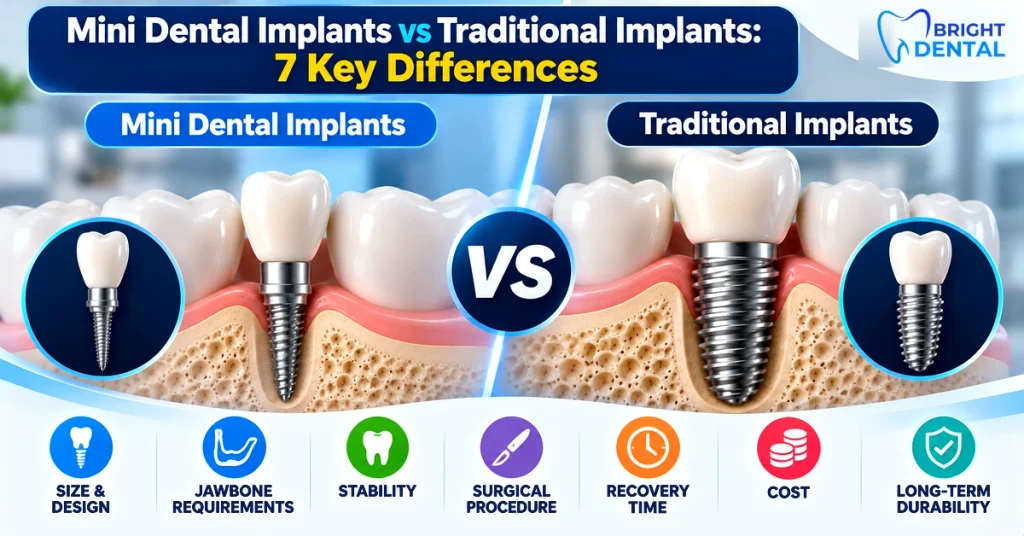
Mini Dental Implants vs Traditional Implants: 7 Key Differences
1. Implant Size
Mini implants have narrower bodies, while traditional implants are generally wider.
The smaller design may be useful when space is limited.
However, implant selection depends on bone structure, restoration requirements, and chewing forces.
Key Point: Smaller does not automatically mean better.
2. Jawbone Requirements
Adequate jawbone support is essential for successful implant placement.
Mini implants may be considered in selected cases with limited jawbone width, although adequate bone quality and volume are still essential.
Traditional implants sometimes require additional bone preparation.
However, both options need sufficient healthy bone.
Key Point: Your dentist must evaluate bone height, width, and quality.
3. Stability and Chewing Strength
Traditional implants are commonly used for larger restorations, including bridges and molars.
Mini implants are often considered for lower denture stabilization or selected smaller restorations.
When comparing mini dental implants vs traditional implants, chewing forces and restoration design are important considerations.
Key Point: Traditional implants offer broader restorative flexibility.
4. Surgical Procedure
Some mini implants can be placed using a relatively conservative surgical technique.
Traditional implant placement may involve additional preparation, especially when bone grafting is necessary.
However, surgical complexity depends on individual anatomy.
Key Point: Both procedures require professional planning and placement.
5. Healing and Recovery
Mini dental implant recovery depends on the number of implants, bone health, and surgical technique.
Some mini implant procedures involve less initial discomfort.
Traditional implants may require several months of healing before final restoration.
Faster placement does not necessarily mean faster biological healing.
Key Point: Follow your dentist’s recovery instructions.
6. Treatment Cost
Mini dental implant cost depends on the number of implants, the type of restoration, and any additional treatment required.
Mini implants may cost less upfront in certain cases.
However, total expenses depend on:
- Number of implants
- Diagnostic imaging
- Bone grafting
- Restoration materials
- Follow-up appointments
Several mini implants may cost more than a simpler traditional implant treatment.
Comparing mini dental implants vs traditional implants also means considering the complete cost of treatment rather than just the initial implant price. Read our Dental Implants Cost Guide.
Key Point: Compare complete treatment estimates.
7. Long-Term Durability
The mini dental implant lifespan depends on proper placement, oral hygiene, bone health, and regular dental care.
Traditional implants have more extensive long-term evidence across different applications.
Mini implants may also perform successfully in carefully selected cases.
Neither option is guaranteed to last a lifetime.
Key Point: Regular maintenance and appropriate treatment selection matter.
Traditional dental implants have more extensive long-term clinical evidence, while the durability of mini dental implants can vary depending on individual conditions and ongoing care.
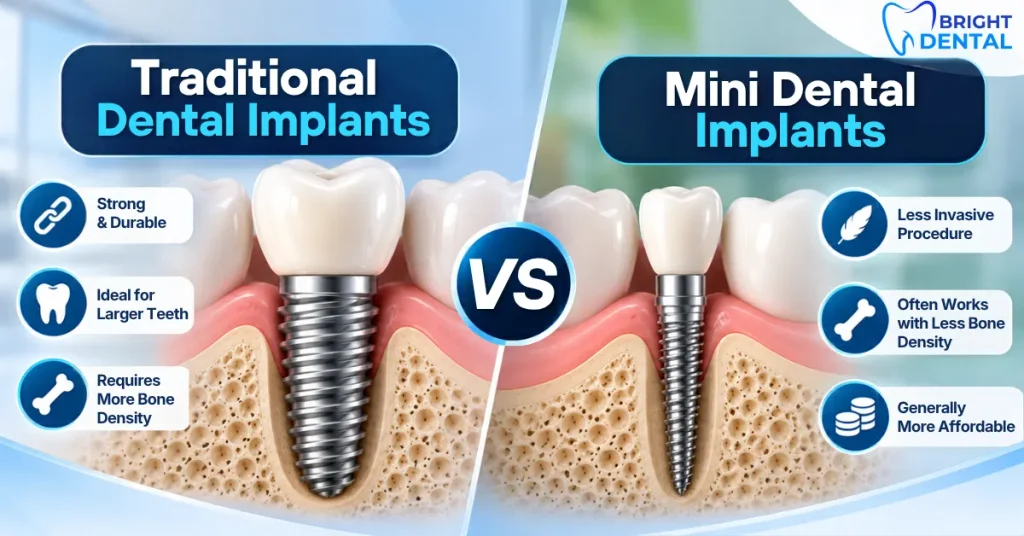
Mini Dental Implants vs Traditional Implants: Comparison Table
| Feature | Mini Implants | Traditional Implants |
|---|---|---|
| Size | Narrower | Generally wider |
| Common Uses | Denture stabilization | Crowns, bridges, dentures |
| Bone Requirements | May fit narrow ridges | May need more bone |
| Procedure | Sometimes less invasive | Depends on complexity |
| Recovery | Varies by patient | Varies by patient |
| Cost | Sometimes lower upfront | Often higher upfront |
| Long-Term Evidence | More limited for some uses | Extensive |
| Best Candidates | Selected patients | Broader restorative needs |
A professional examination is necessary to determine the appropriate treatment.
Who Is a Good Candidate?
Mini dental implant candidates are selected based on jawbone condition, oral health, and treatment requirements.
Learn more about dental implant candidacy to understand which factors may affect your suitability for implant treatment.
Mini Implants May Suit Patients Who:
- Need improved denture stability
- Have limited jawbone width
- Require selected smaller restorations
- Have suitable bone and gum health
Traditional Implants May Suit Patients Who:
- Need individual tooth replacement
- Require dental bridges
- Want implant-supported dentures
- Need extensive tooth restoration
Your dentist will evaluate your oral health, medical history, and treatment goals.
The American Academy of Periodontology provides additional information about periodontal health and dental implant care.
How to Maintain Dental Implants
Proper maintenance supports the long-term success of both options.
Follow these essential habits:
- Brush twice daily.
- Clean between teeth and around implants.
- Attend regular dental checkups.
- Avoid tobacco use.
- Report swelling, bleeding, or implant movement.
Implants cannot develop cavities, but the surrounding gums and bone can develop inflammation or disease.
Why Choose Bright Dental?
25 Years of Local Experience: Dr. Furrukh Ashraf has served the Des Plaines community for over two decades, providing personalized dental care.
Our team helps patients understand tooth replacement options through personalized consultations and treatment planning.
We consider your oral health, jawbone condition, and restoration goals before discussing suitable implant treatments.
Frequently Asked Questions
1. Are Mini Dental Implants Better?
Not necessarily. Mini implants may suit selected patients, while traditional implants offer broader restorative applications.
2. Are Mini Dental Implants Cheaper?
Sometimes. The cost difference between mini dental implants vs traditional implants depends on implant numbers, restoration type, and additional procedures. Your dentist can provide an accurate estimate after an examination.
3. Can Mini Implants Replace Molars?
They are not routinely the first choice for heavily loaded molars. A dentist must evaluate each case.
4. Do Mini Implants Last as Long?
Both can provide long-term function, but outcomes vary. Traditional implants have more extensive long-term evidence.
5. Can Mini Implants Avoid Bone Grafting?
In selected cases, yes. However, adequate healthy bone is still necessary.
6. How much do mini dental implants cost compared to traditional implants?
Answer mein explain karo ke cost implant number, restoration aur additional procedures par depend karti hai. Exact pricing bina examination ke promise mat karna.
Conclusion
Comparing mini dental implants vs traditional implants helps patients understand their tooth replacement options.
Mini implants may be useful for selected denture treatments and narrow jawbone areas.
Traditional implants offer greater flexibility for crowns, bridges, and extensive restorations.
The best choice depends on your oral health, jawbone anatomy, budget, and long-term needs.
Understanding mini dental implants vs traditional implants makes it easier to compare treatment options and discuss your needs with a qualified dentist.
Restore Your Smile With Bright Dental!
Missing teeth shouldn’t stop you from enjoying everyday activities or feeling confident about your smile.
At Bright Dental in Des Plaines, IL, our team can help you explore mini and traditional dental implant options based on your individual dental needs.
We welcome patients from Des Plaines, Mount Prospect, Buffalo Grove, Wilmette, and Wheeling.
Bright Dental II – Des Plaines
Address: 737 W Golf Rd, Des Plaines, IL 60016, USA
Phone: +1 (847) 228-2000

