
One of the first questions most patients ask before moving forward with treatment is simple: how much do dental implants cost? The honest answer is that dental implants cost varies widely from patient to patient, since no two cases are exactly alike. In this guide from Bright Dental, you will learn what drives the price up or down, how it compares to other tooth replacement options, and how to get an accurate quote for your own case.
Quick answer: Dental implants cost depends on how many teeth are being replaced, the type of restoration, whether bone grafting is needed, and the materials used. A single tooth implant typically costs less than a full-arch solution like All-on-4.
Why Is There No Single Answer to This Question?
Unlike a flat-fee service, implant treatment is built around your individual anatomy and goals. Two patients missing the same tooth can still end up with different dental implants cost totals, since one might need a bone graft first while the other does not. This is why your dentist can only give an accurate number after an exam and imaging, not before.
7 Key Factors That Affect Dental Implants Cost
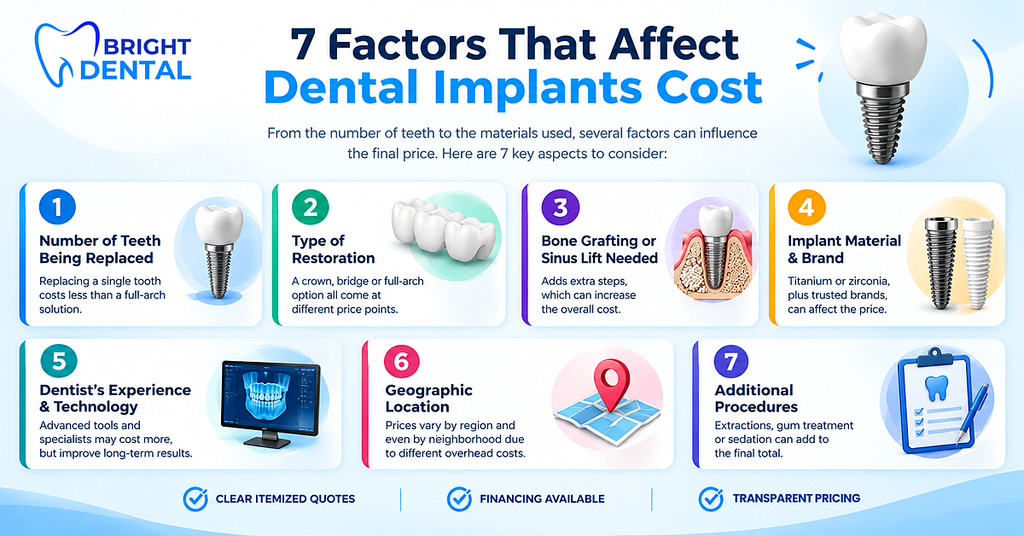
1. Number of Teeth Being Replaced
Replacing a single tooth with a dental implant is generally the least expensive option, while replacing a full arch with multiple implants naturally costs more, since it involves more implants, more lab work, and a larger custom restoration.
2. Type of Restoration
A single crown, a multi-tooth bridge, and a full-arch solution like All-on-4 all come at different price points. Full-arch treatment tends to cost more upfront but can be more cost-effective per tooth replaced compared to placing several single implants.
3. Need for Bone Grafting or a Sinus Lift
If your jawbone has thinned from years without a tooth root, a bone graft or sinus lift may be needed before implants can be placed. This adds to the overall price but is often necessary for a stable, lasting result.
4. Implant Material and Brand
Implants are made from different grades of titanium or, less commonly, zirconia. Premium brands with a longer track record of research often cost more than lesser-known alternatives.
5. The Dentist’s Experience and Technology Used
Clinics that use 3D imaging, guided surgery, and experienced specialists may charge more, but this often reduces complications and the need for costly corrections later.
6. Geographic Location
Prices vary by region and even by neighborhood within the same metro area, largely due to differences in overhead costs like rent and staffing.
7. Additional Procedures
Tooth extractions, gum disease treatment, or sedation options can all add to the final total, depending on your starting oral health.
How Does Dental Implants Cost Compare to Other Options?
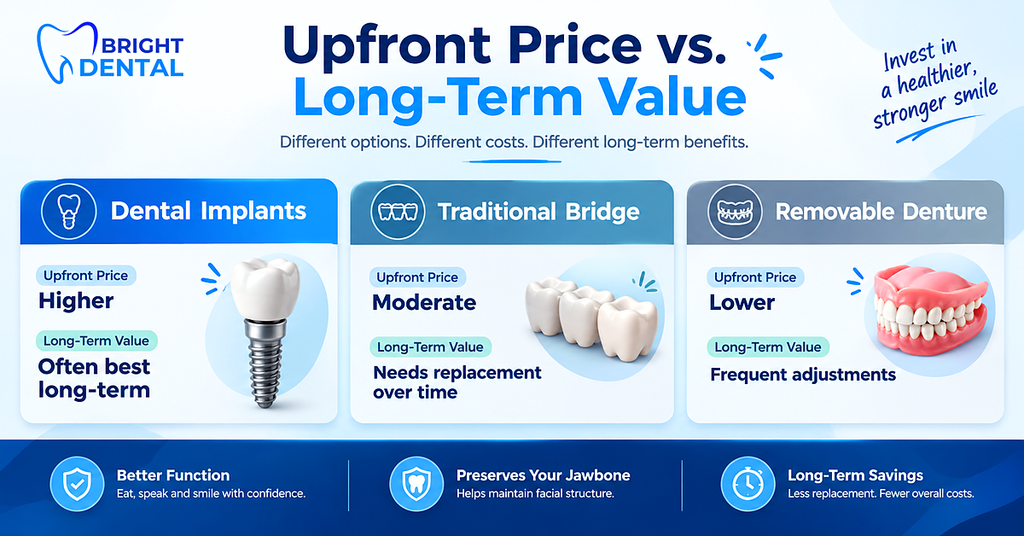
| Feature | Dental implants | Traditional bridge | Removable denture |
|---|---|---|---|
| Upfront price | Higher | Moderate | Lower |
| Long-term value | Often best, since implants can last decades | Moderate, needs replacement over time | Lowest, frequent adjustments and replacements |
| Bone preservation | Yes | No | No |
| Daily maintenance | Minimal, brush as normal | Minimal, brush as normal | Removal and cleaning required |
While a denture or bridge may look cheaper on paper, these options often need to be replaced or adjusted over the years, which adds to their lifetime cost. Implants tend to have a higher upfront price but a lower cost over a decade or more.
Does Insurance Cover Dental Implants?
Coverage varies significantly between insurance plans. Some dental plans cover a portion of the crown or restoration but exclude the implant post itself, while others offer no implant coverage at all. Medical insurance may occasionally contribute if the tooth loss resulted from an accident or medical condition. For more information about dental expenses, insurance, and payment options, explore the ADA’s guide to paying for dental care.
Financing Options to Make Treatment More Affordable
Dental implants cost does not have to be paid all at once. Many patients do not pay the full amount upfront. Common ways to manage the expense include:
- Monthly payment plans offered directly through the dental office
- Third-party healthcare financing companies with flexible terms
- Health savings accounts or flexible spending accounts, where eligible
- Prioritizing treatment in phases, starting with the most urgent teeth first
Why Be Cautious of Unusually Low Prices
Heavily discounted implant offers, especially from unfamiliar providers, can sometimes mean lower-quality materials, less experienced providers, or hidden fees added later for imaging, medication, or follow-up visits. A thorough consultation and a clear, itemized quote help you understand exactly what your dental implants cost includes before you commit.
How to Get an Accurate Quote
- Schedule a Consultation: an exam and imaging are the only way to know your exact needs, including whether a bone graft is required
- Ask for an Itemized Breakdown: a clear quote should separate the cost of the implant, the restoration, any grafting, and follow-up visits
- Ask About Payment Plans: many practices offer financing that spreads the expense over several months
- Compare Value, Not Just Price: the lowest quote is not always the best value if it skips imaging, uses lower-grade materials, or lacks a warranty
Frequently Asked Questions
Why do dental implants cost more than dentures?
Implants involve a surgical procedure, specialized materials, and a longer-lasting result, which generally makes the upfront price higher than a removable denture, though implants often prove more cost-effective over time.
Can I negotiate the price of dental implants?
While pricing is not usually negotiable the way it might be for a retail purchase, your dentist may be able to suggest a treatment plan or payment option that better fits your budget.
Are cheaper implants overseas worth considering?
Traveling for lower prices carries added risks, including limited follow-up care, different regulatory standards, and the cost of a return trip if a complication arises.
Does the type of implant affect the price?
Yes. A single tooth implant typically costs less than a full-arch option, since full-arch treatment involves more implants and a larger restoration.
Conclusion
Dental implants cost depends on several factors, from the number of teeth being replaced to the materials used and whether additional procedures like bone grafting are needed. While the upfront price can be higher than a bridge or denture, implants often provide better long-term value thanks to their durability and bone-preserving benefits.
Looking for a Dental Implants Cost Estimate Near Lincolnshire, Deerfield, or Riverwoods?
Bright Dental proudly serves patients from Des Plaines, Mount Prospect, Lincolnshire, Deerfield, and Riverwoods. Our team provides a clear, itemized quote after your consultation, so you know exactly what to expect before moving forward.
