
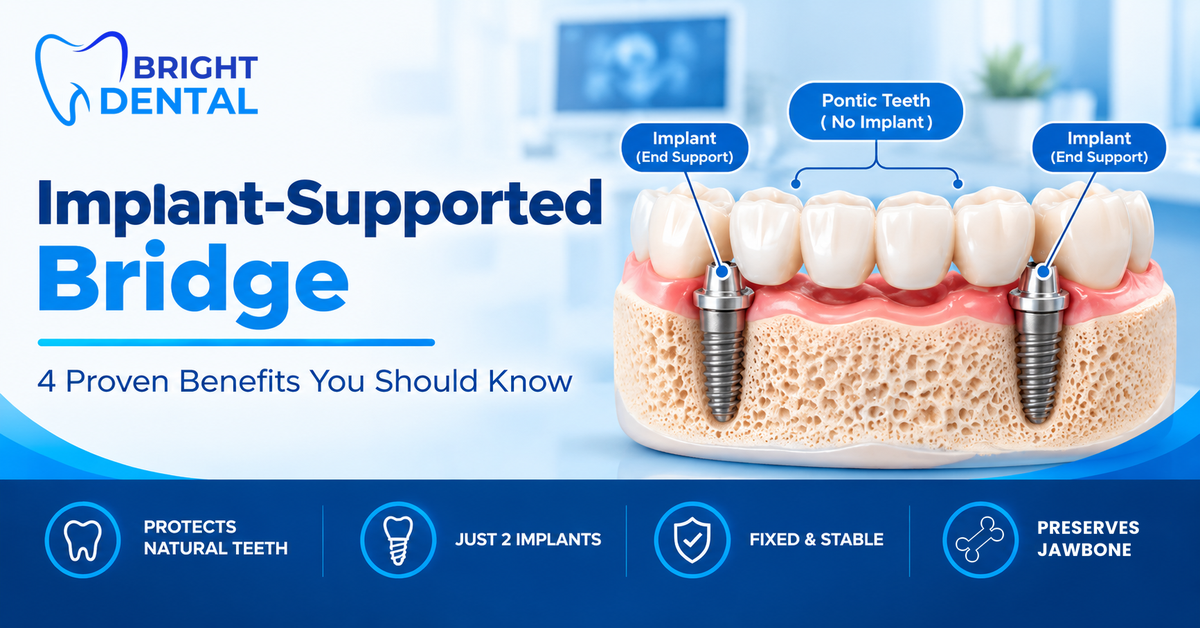

Losing several teeth in a row is different from losing just one. An implant-supported bridge replaces multiple missing teeth at once, using only a pair of implants to anchor the entire span. In this guide from Bright Dental, you will learn how an implant-supported bridge works, its benefits, and what to expect from start to finish.
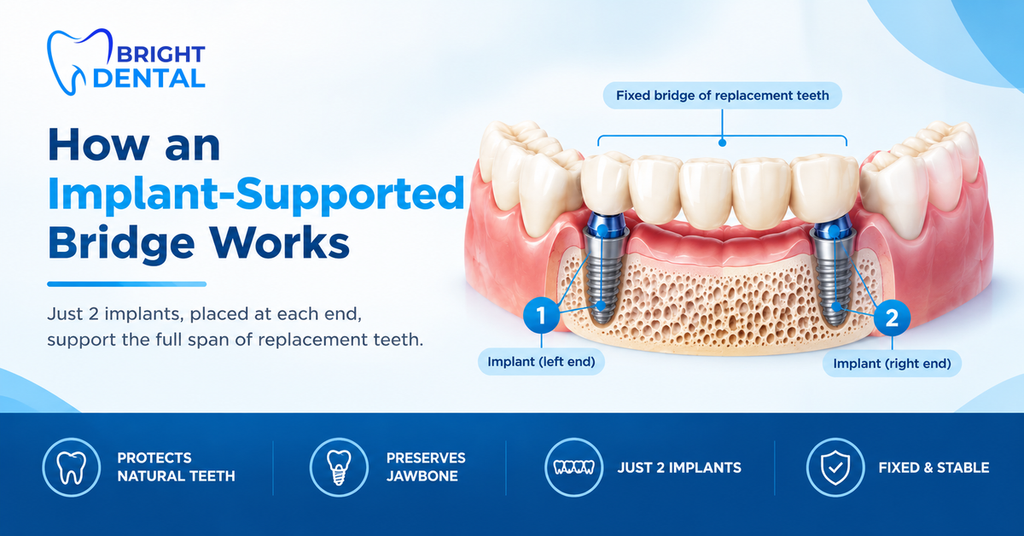
Quick answer: This treatment uses two dental implants, placed on either end of a gap, to support a fixed bridge of replacement teeth in between. No implant is needed under every missing tooth.
What Is an Implant-Supported Bridge?
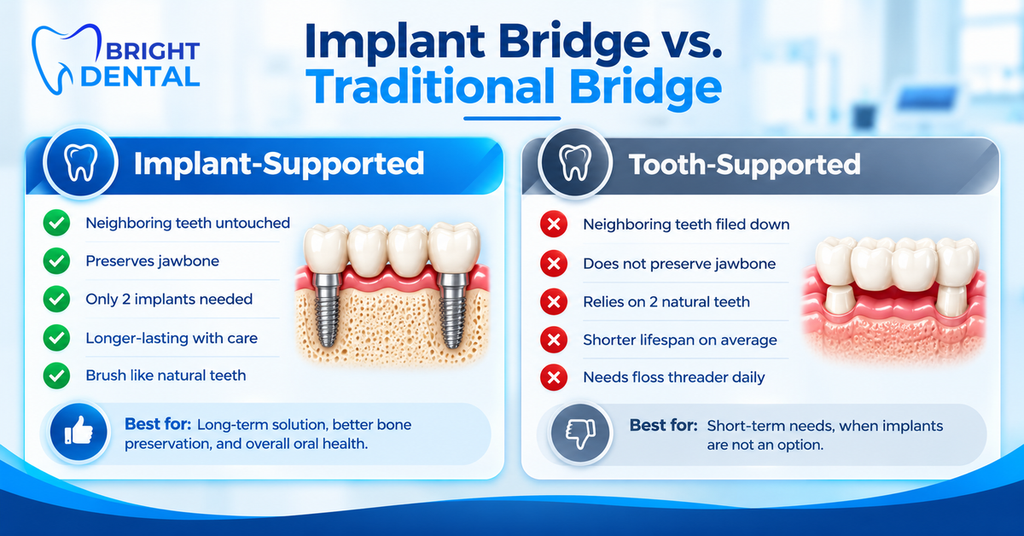
A traditional bridge relies on your natural teeth, on either side of a gap, to be ground down and support a false tooth in between. An implant-supported bridge replaces that reliance on natural teeth with dental implants instead.
The implants are placed in the jawbone at each end of the missing teeth. Once healed, a custom bridge, usually covering three or more teeth, is attached to the implants, filling the gap with a fixed, non-removable restoration.
4 Proven Benefits of an Implant-Supported Bridge
- Protects healthy teeth: neighboring natural teeth are not filed down or weakened to support the bridge, unlike a traditional tooth-supported bridge
- Preserves jawbone: the implants stimulate the jawbone the same way natural tooth roots do, reducing bone loss in that area
- Fewer implants than you might expect: a span of three or four missing teeth often needs only two implants, one at each end
- Fixed and stable: the bridge does not come out, shift, or require the adhesives a removable partial denture needs
How It Compares to Other Options
| Feature | Implant-supported bridge | Traditional tooth-supported bridge | Removable partial denture |
|---|---|---|---|
| Affects neighboring teeth | No | Yes, teeth are filed down | No |
| Preserves jawbone | Yes | No | No |
| Stability | Fixed, does not move | Fixed, does not move | Can shift while eating |
| Daily care | Brush like natural teeth | Brush like natural teeth | Remove and soak nightly |
| Typical lifespan | Long-lasting with care | Shorter, due to strain on anchor teeth | Shortest of the three |
The Procedure: What to Expect
1. Consultation and Planning
Your dentist examines the gap, checks bone density at the two implant sites, and plans the size of the bridge needed.
2. Implant Placement
Two implants are placed in the jawbone, one at each end of the missing teeth, under local anesthesia.
3. Healing
Over the following months, the bone fuses around each implant, creating a stable foundation for the bridge.
4. Bridge Attachment
Once healed, a custom-made bridge is attached to the two implants, completing the restoration and closing the gap.
Some patients receive a temporary bridge or tooth to wear during the healing period, so the gap is never left empty.
Who Is a Good Candidate?
This option is often recommended for patients who:
- Are missing three or more teeth in a row
- Have healthy implant sites at each end of the gap
- Want to avoid grinding down healthy neighboring teeth
- Prefer a fixed solution over a removable partial denture
- Are in good general health with adequate bone at the two implant positions
A dental exam with imaging confirms whether this approach fits your specific gap and bone structure.
Recovery and Aftercare
Mild soreness near the two implant sites is normal for a few days and is manageable with medication your dentist recommends.
Simple aftercare tips:
- Stick to softer foods while the implant sites heal
- Avoid smoking, which slows healing
- Keep the area clean as your dentist instructs
- Attend follow-up visits so healing can be monitored
- Once the bridge is attached, floss underneath it using a floss threader or water flosser as directed
Frequently Asked Questions
How many implants does a bridge need?
Often just two, one at each end of the gap, regardless of how many teeth sit in between, as long as the span is not too long for the jawbone to support.
Is this different from a single tooth implant?
Yes. A single tooth implant replaces one missing tooth with its own implant and crown, while this option replaces several teeth in a row using implants only at the ends.
How long does an implant-supported bridge last?
With good oral hygiene and regular checkups, the implants and bridge can last many years, often longer than a traditional tooth-supported bridge.
Will my bite feel normal afterward?
Yes, once healed, the bridge is designed to match your natural bite and blend in with your surrounding teeth.
Conclusion
An implant-supported bridge offers a fixed, long-term way to replace several missing teeth without grinding down healthy neighboring teeth. By anchoring the bridge with just two implants, this treatment combines the stability of implants with the efficiency of replacing multiple teeth at once.
Looking for an Implant-Supported Bridge Near Prospect Heights?
Bright Dental proudly serves patients from Des Plaines, Mount Prospect, and Prospect Heights. If you are missing several teeth in a row and want a fixed solution that protects your healthy teeth, our team can help you find the right fit.
