
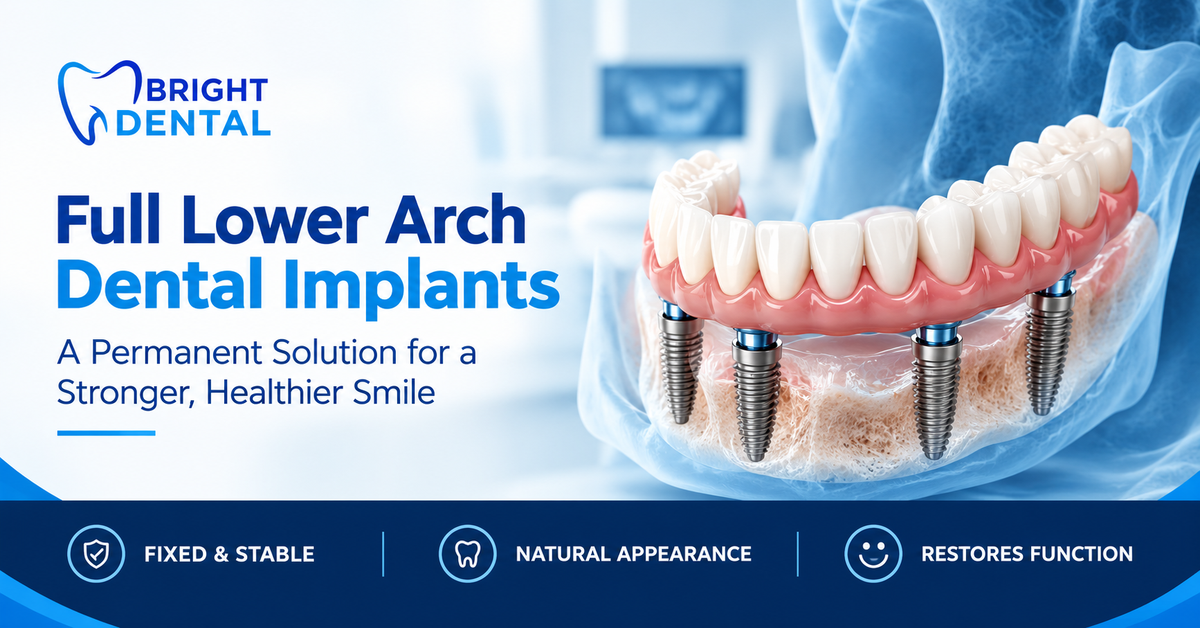

Missing most or all of your lower teeth can affect chewing, speech, comfort, and your confidence. Full lower arch dental implants can replace an entire row of missing lower teeth with a fixed, implant-supported bridge, designed around the structure of the lower jaw. In this guide from Bright Dental, you will learn how the lower arch differs from the upper arch, what the treatment involves, and what to expect from start to finish.
Quick answer: Full lower arch dental implants replace an entire row of missing lower teeth using multiple implants anchored in the jawbone to support one fixed, custom-made bridge.
Fact 1: The Lower Jaw Has Its Own Advantages and Considerations
The lower jawbone, called the mandible, is generally denser than the upper jaw. This can provide a stable foundation for implants, and bone grafting may be needed less often in the lower arch than in some upper-arch cases.
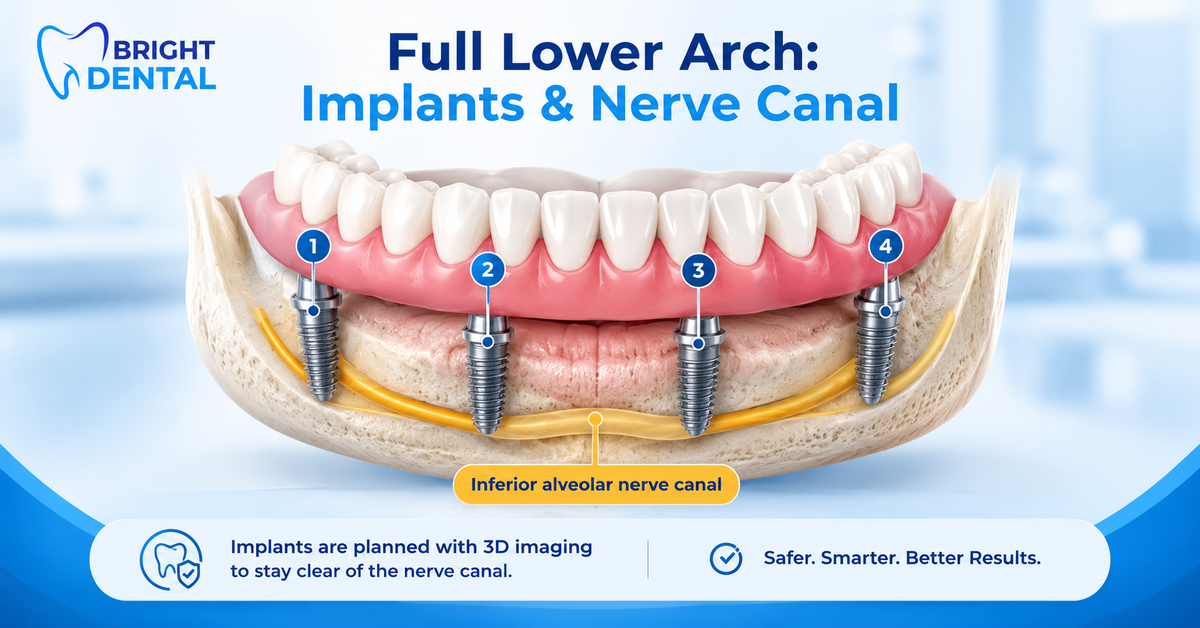
However, the lower jaw has an important factor to plan around: the inferior alveolar nerve. This nerve runs through the lower jawbone and supplies feeling to the lower lip and chin. Implant positions are carefully planned with imaging to stay clear of this nerve.
Fact 2: The Number of Implants Can Vary
Many full lower arch cases can be supported by four implants, following the same basic principle used in the All-on-4 approach. Some patients may need five or six implants depending on their bone structure, bite, available bone, and overall treatment plan.
Your dentist determines the exact number using 3D imaging to evaluate the available bone and the position of the nerve canal.
Fact 3: It Restores Bite and Jaw Function
For patients with extensive lower tooth loss, full lower arch dental implants can help restore chewing stability and the appearance of the smile. A fixed implant-supported restoration may:
- Improve chewing stability compared with a conventional lower denture
- Help preserve bone around the implant sites after tooth loss
- Support clearer speech by providing a stable replacement for missing teeth
- Restore the appearance of the lower smile
Fact 4: The Treatment Process Involves Several Stages
1. Consultation and 3D Imaging
Your dentist reviews your bone structure, bite, remaining teeth, and the position of the nerve canal using detailed imaging. This helps create a precise treatment plan for full lower arch dental implants.
2. Tooth Removal and Site Preparation
Any remaining damaged or non-restorable teeth may need to be removed. Because the lower jaw is often denser than the upper jaw, additional bone grafting may be less commonly needed, although each patient is different.
3. Implant Placement
The implants are positioned in suitable areas of available bone while carefully planning around the nerve canal. The exact position and number of implants depend on your anatomy and treatment goals.
4. Temporary Fixed Teeth
Some patients may receive a temporary fixed bridge on the day of surgery or shortly afterward. Whether immediate temporary teeth are possible depends on implant stability, bone quality, and your individual treatment plan.
5. Healing and Final Restoration
During the following months, the bone gradually integrates with the implants. Once healing and stability are confirmed, a custom permanent bridge can replace the temporary restoration.
Fact 5: Recovery Is Generally Manageable With Proper Aftercare
Mild swelling, tenderness, or bruising can occur during the first few days after implant surgery. Your dentist will provide specific instructions and recommend medication when appropriate.
Simple aftercare tips:
- Stick to soft, cool foods for the first several days or as recommended by your dentist.
- Avoid smoking, which can interfere with healing and increase the risk of complications.
- Keep the surgical area clean according to your dentist’s instructions.
- Report unusual or persistent numbness in the lip or chin to your dentist promptly.
- Attend every follow-up appointment so healing can be monitored.
Many patients return to normal daily activities within a few days after Full lower arch dental implants, but complete healing and implant integration can take several months.
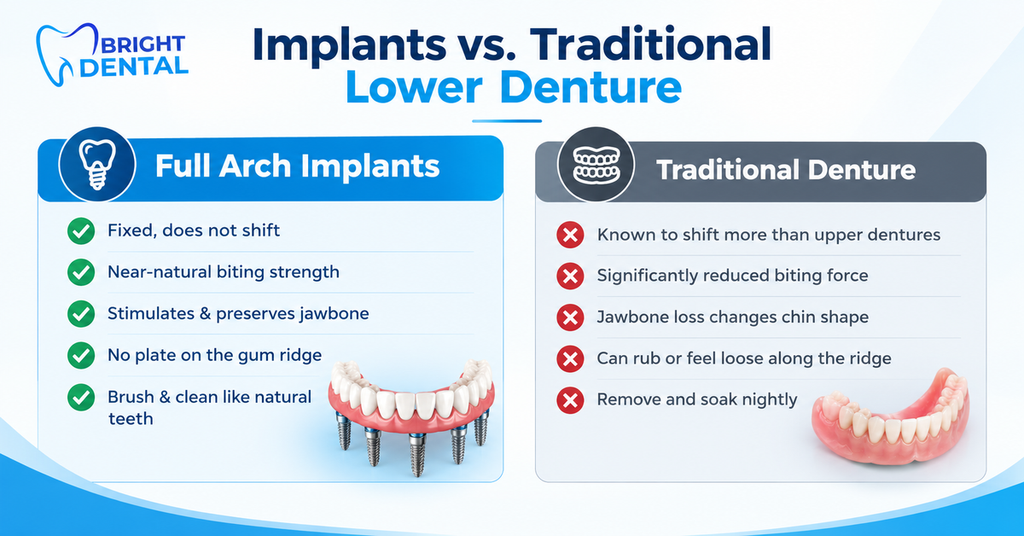
Full Lower Arch Dental Implants vs. Traditional Lower Denture
| Feature | Full lower arch implants | Traditional lower denture |
|---|---|---|
| Stability | Fixed and supported by implants | Removable and may move during chewing or speaking |
| Bone preservation | Helps preserve bone around implant sites | Jawbone loss can continue after tooth loss |
| Chewing function | Improved stability and chewing ability | Typically less stable than a fixed implant restoration |
| Daily care | Cleaned similarly to fixed teeth, with special areas around implants | Removed for cleaning and usually soaked as directed |
| Comfort | No large removable plate | May feel loose or rub against the gums |
Lower dentures can be particularly challenging for some patients because the tongue and lower-jaw muscles are active during speech and chewing. For suitable candidates, a fixed implant-supported solution can provide greater stability than a conventional lower denture.
How Full Lower Arch Dental Implants Compare With Full Upper Arch Treatment
While the overall treatment process is similar, the Lower arch dental impants and Upper arch dental implants have important differences:
- The lower jawbone is generally denser, which can provide a strong foundation for implants.
- There is no sinus cavity in the lower jaw, but the inferior alveolar nerve requires careful planning.
- Conventional lower dentures can be less stable for some patients, making fixed implant-supported treatment an attractive option when appropriate.
Who Is a Good Candidate?
Full lower arch dental implants may be considered for patients who:
- Full lower arch dental implants may be considered for patients who are missing most or all of their lower teeth.
- Wear a lower denture that feels loose, unstable, or uncomfortable
- Have sufficient bone or may be able to proceed after appropriate bone preparation
- Want a fixed, non-removable alternative to a conventional denture
- Are in suitable overall health for implant treatment
A dental examination and 3D imaging are needed to confirm candidacy and determine the right number and position of implants.
Frequently Asked Questions
Why does the lower arch often have favorable bone conditions for implants?
The mandible is generally denser than the upper jaw, which can provide a stable foundation for implants. However, bone quality and quantity vary from patient to patient.
Will I feel numbness after the procedure?
After Full lower arch dental implants, temporary numbness in the lower lip or chin can occur after lower-jaw implant surgery because the nerve supplying these areas runs through the jaw. Persistent or worsening numbness should be reported to your dentist promptly.
How long does the full process take?
Treatment timelines vary. Some patients may receive temporary fixed teeth on the day of surgery, while the final bridge is typically placed after a period of healing and implant integration.
Can I get both upper and lower full arch implants at the same time?
Some patients may qualify for treatment of both arches together, while others may complete one arch first. Your dentist will recommend an approach based on your bone structure, oral health, and overall treatment plan.
Conclusion
Full lower arch dental implants are designed around the anatomy of the mandible and can provide a fixed, stable way to restore chewing function and the appearance of your smile. With careful planning around the nerve canal and a treatment plan based on your individual bone structure, they can be a long-term option for suitable patients.
Looking for Full Lower Arch Dental Implants Near Glenview?
Bright Dental proudly serves patients from Des Plaines, Mount Prospect, and Glenview. If you are missing most or all of your lower teeth and want a stable, fixed solution, our team can evaluate your jaw structure and help determine whether full lower arch dental implants are right for you.

