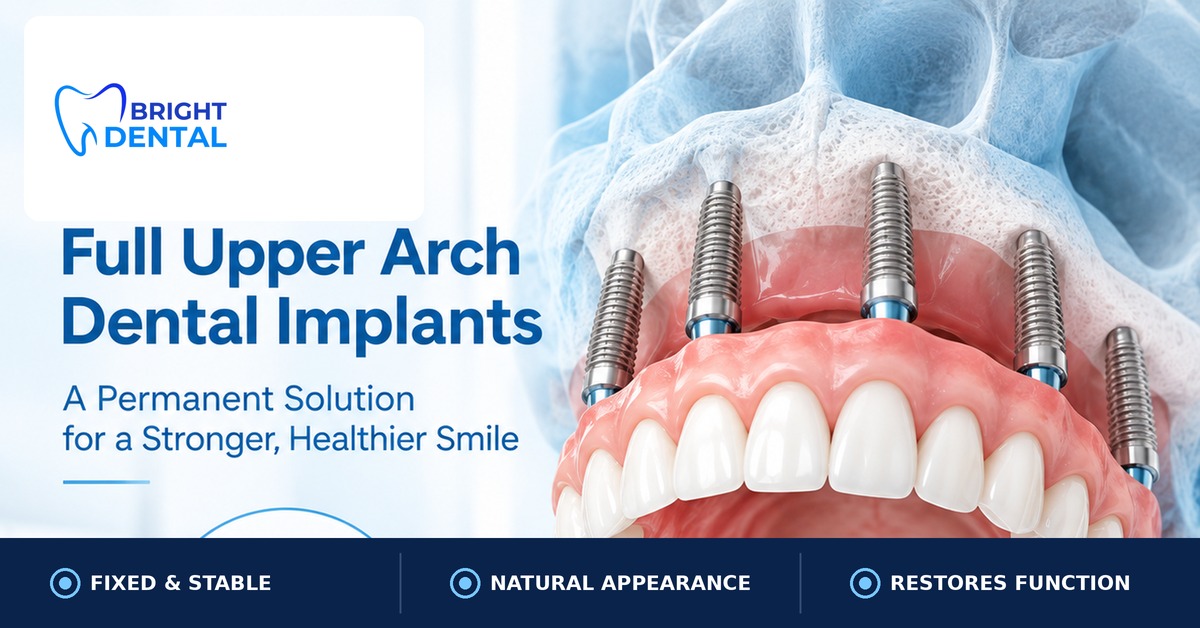

Replacing a full row of missing upper teeth is not the same as replacing the lower arch. The upper jaw has its own bone structure, sits close to the sinus cavities, and plays a bigger role in how your smile looks. Full upper arch dental implants are designed around these differences, giving you a fixed, natural-looking solution built specifically for the top of your mouth. In this guide from Bright Dental, you will learn why the upper arch is treated differently, your treatment options, and what to expect from full upper arch dental implants.
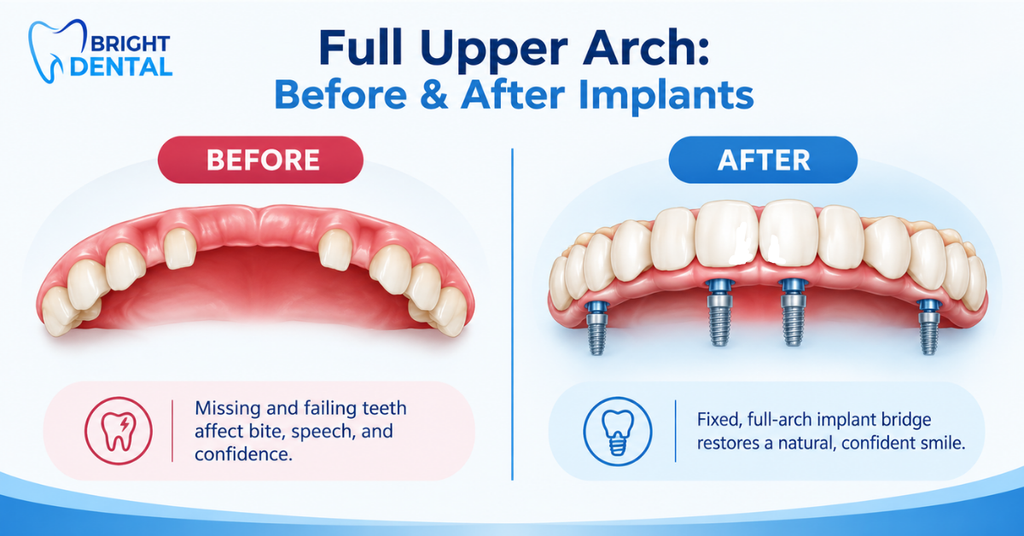
Quick answer: Full upper arch dental implants replace an entire row of missing upper teeth using a set of implants, usually four to six, anchored in the jawbone to support one fixed, custom-made bridge.
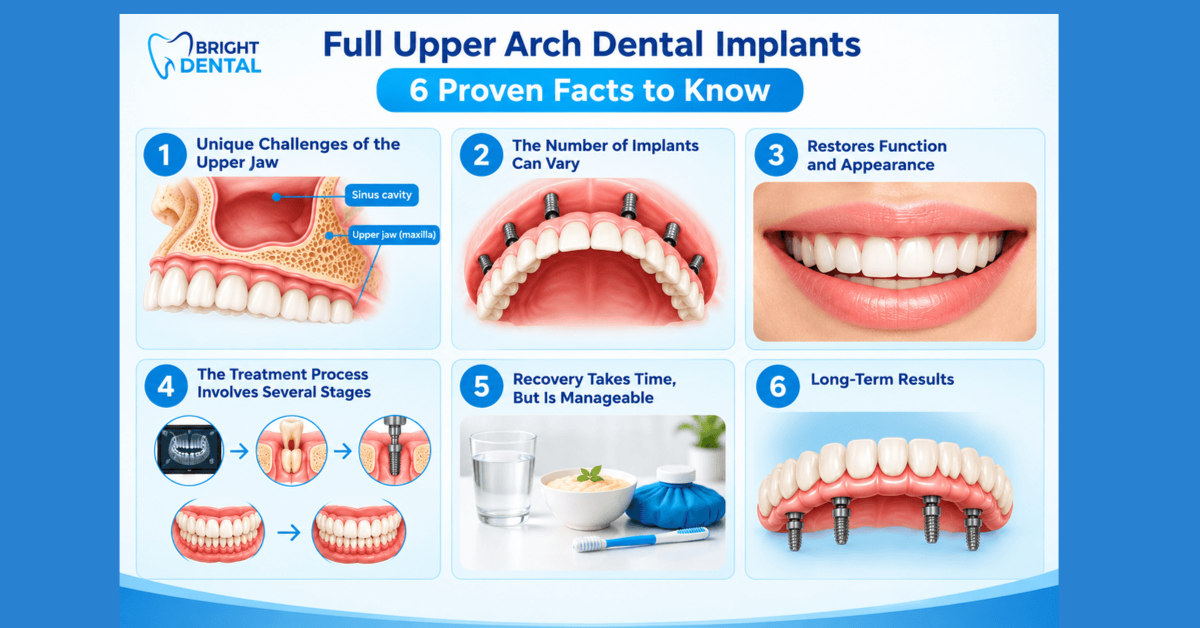
Fact 1: The Upper Jaw Has Unique Challenges
The upper jawbone, called the maxilla, is naturally softer and more porous than the lower jaw. It also sits close to the sinus cavities, two air-filled spaces behind your cheeks. These two factors affect how implants are planned and placed:
- Softer bone means implants often need to be placed at specific angles or in denser areas to stay stable
- Sinus proximity means some implant positions require extra planning, and a sinus lift procedure is sometimes needed to build up bone before placement
This is why an upper arch case is rarely treated with a one-size-fits-all approach.
Fact 2: The Number of Implants Can Vary
Because the upper jawbone is softer, the number of implants used for a full upper arch restoration can vary from patient to patient. While some patients qualify for a four-implant approach, others may need additional implants to provide adequate support and distribute chewing forces.
Your dentist determines the right number based on your bone density, your bite, and imaging from a 3D scan.
Fact 3: Full Upper Arch Dental Implants Restore Function and Appearance
Losing the upper teeth affects more than chewing. The upper arch supports your lips and cheeks, so missing teeth can cause the face to look sunken over time. A full upper arch restoration:
- Restores your ability to bite and chew normally
- Supports facial structure and lip fullness
- Full upper arch dental implants can help restore both function and the appearance of the smile.
Fact 4: The Treatment Process Involves Several Stages
1. Consultation and 3D Imaging
Your dentist evaluates your bone density, sinus position, and bite using a detailed scan to plan exact implant placement. This information also helps create a personalized plan for full upper arch dental implants.
2. Tooth Removal and Site Preparation
Any remaining damaged teeth are removed. If bone volume is low near the sinus, a sinus lift may be performed to add bone before or during implant placement.
3. Implant Placement
The implants are positioned in the strongest available bone, often at the front and sides of the arch to avoid the sinus cavities.
4. Temporary Fixed Teeth
Many patients receive a temporary bridge on the same day, so the upper arch is never left without teeth during healing. However, timing can vary depending on the patient’s individual case.
5. Healing and Final Restoration
Over the following months, the bone fuses around the implants. Once stable, a custom, permanent bridge replaces the temporary one, matched to your facial proportions and smile line.
Fact 5: Recovery Takes Time, But Is Manageable
Mild swelling and tenderness in the first few days is normal, especially since the upper arch procedure can involve more tissue than a single-tooth case.
Simple aftercare tips:
- Stick to soft, cool foods for the first several days
- Avoid blowing your nose forcefully if a sinus lift was performed, since this can affect healing
- Avoid smoking, which slows healing significantly
- Keep the surgical area clean as your dentist instructs
- Attend every follow-up visit so healing can be monitored closely
Most patients return to normal daily activities within a few days, while full bone healing takes several months.
Fact 6: Full Upper Arch Dental Implants Can Provide Long-Term Results
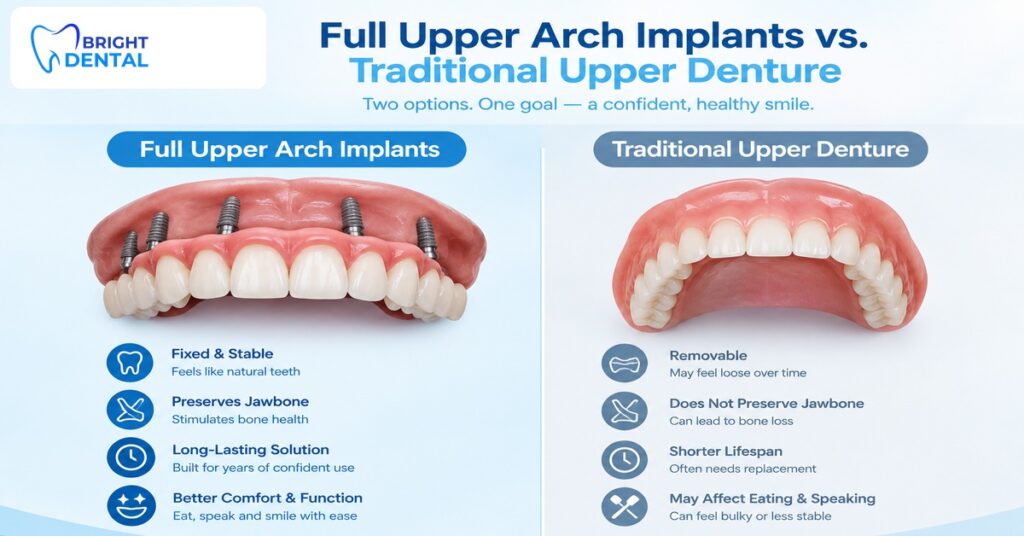
With good oral hygiene and regular dental visits, a full upper arch implant restoration can last for decades. Because the bridge is fixed rather than removable, patients avoid the slipping, clicking, and bone loss commonly associated with traditional upper dentures.
Full Upper Arch Implants vs. Traditional Upper Denture
| Feature | Full upper arch implants | Traditional upper denture |
|---|---|---|
| Stability | Fixed, does not move | Can shift, especially when speaking |
| Taste sensation | Full palate exposed to food | Often covered by denture plate |
| Bone preservation | Implants stimulate the jawbone | Bone loss continues over time |
| Daily care | Brush like natural teeth | Remove and soak nightly |
| Facial support | Maintains natural lip and cheek support | May require extra bulk for support |
One detail patients often appreciate: because implant-supported bridges do not need to cover the roof of the mouth like a traditional denture plate does, taste and comfort are usually much closer to natural teeth.
Who Is a Good Candidate?
Full upper arch dental implants may be considered for patients who:
- Are missing most or all of their upper teeth
- Wear an upper denture that feels loose, bulky, or affects taste
- Have enough bone, or are open to a sinus lift if needed
- Want a fixed, non-removable option rather than a removable denture
- Are in good general health and do not smoke, or are willing to quit during healing
A dental exam with imaging is the only way to confirm your exact candidacy and implant plan.Your dentist can also determine whether full upper arch dental implants are appropriate for your individual needs.
Frequently Asked Questions
Why does the upper arch sometimes need more implants than the lower arch?
The upper jawbone is naturally softer, and some areas near the sinus cannot be used for implant placement, so the number of implants may vary depending on the patient’s anatomy and treatment plan.
Will I need a sinus lift?
Not always. It depends on how much bone is available near your sinus cavities, which your dentist checks with imaging before planning treatment.
How long does the full process take?
Timelines vary, but many patients receive temporary fixed teeth on the same day as surgery, with the final bridge placed after several months of healing.
Is this the same as All-on-4?
All-on-4 is one specific technique used for full-arch replacement. Full upper arch dental implants may use four, five, six, or another number of implants depending on your bone structure and treatment plan, so your dentist will recommend the approach appropriate for your case.
How do I know if full upper arch implants are right for me?
A comprehensive dental examination and 3D imaging can help determine whether full upper arch dental implants are suitable for you.
Looking for Full Upper Arch Dental Implants Near Wheeling?
Bright Dental proudly serves patients from Des Plaines, Mount Prospect, and Wheeling. If you are missing most or all of your upper teeth and want a fixed, long-term solution built around your facial structure, our team can guide you through every stage of treatment.
Conclusion
Full upper arch dental implants are built around the unique structure of the upper jaw, from bone density to sinus position to how your smile looks when you speak. With the right number of implants and a carefully planned approach, this treatment offers a fixed, natural-looking way to restore both function and confidence.
Looking for Full Upper Arch Dental Implants Near Wheeling?
Bright Dental proudly serves patients from Des Plaines, Mount Prospect, and Wheeling. If you are missing most or all of your upper teeth and want a fixed, long-term solution built around your facial structure, our team can guide you through every stage of treatment.
