
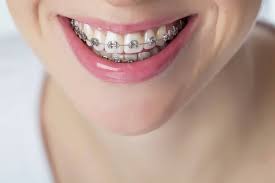

You spent your teenage years without braces — maybe your family couldn’t afford them, maybe your teeth seemed “close enough,” or maybe the idea just never came up. Now you’re an adult, you look at photos of yourself smiling, and something doesn’t sit right. You’ve wondered whether it’s too late, whether braces at your age would look unprofessional, or whether the whole process would even be worth it.
Here’s the truth: orthodontics for adults in Des Plaines, IL is not only possible — it’s one of the fastest-growing areas of dental treatment. At Bright Dental, more than a third of our orthodontic patients are adults. Some are in their 30s, many are in their 40s, and some are well into their 50s and 60s. Age is not a barrier to a straighter, healthier smile. Biology doesn’t have an expiration date when it comes to tooth movement.
This guide is written specifically for adults who are considering orthodontic treatment but have questions, hesitations, or simply don’t know where to start.
Why So Many Adults Are Choosing Orthodontic Treatment Now
For a long time, braces carried a strong association with adolescence — metal brackets, colorful rubber bands, school lunch awkwardness. That image has shifted dramatically, and for good reason.
Several factors are driving more adults toward orthodontic treatment today:
Clear aligner technology has made treatment far more discreet than it was even a decade ago. Many adults in professional or social environments can complete their entire orthodontic treatment without most people around them ever noticing.
Greater awareness of the health benefits beyond aesthetics is motivating adults who previously only thought of orthodontics as cosmetic. Misaligned teeth are genuinely harder to clean, contributing to higher rates of cavities, gum disease, and even TMJ-related jaw pain. Straightening your teeth as an adult is a health decision just as much as an aesthetic one.
Increased financial readiness means many adults are now in a better position to invest in their smiles than they were as teenagers.
Life milestone motivation — a wedding, a significant birthday, a new career chapter, or simply reaching a point where you decide to prioritize yourself — frequently brings adult patients through our door.
Whatever your reason for considering it now, the important thing is that you are considering it. And that’s exactly the right starting point.
Is It Actually Safe to Move Teeth as an Adult?
This is the most medically important question, and the answer is yes — with one important qualifier.
Teeth move in response to controlled, sustained pressure applied to the periodontal ligament — the soft tissue that connects each tooth root to the surrounding bone. This ligament is present and functional throughout your entire life. It does not stop responding to orthodontic force because you turned 30 or 40.
What does change as we age is the density of the surrounding bone. Adult bone tends to be denser than adolescent bone, which means tooth movement can be slightly slower and treatment timelines may be somewhat longer than they would be for a teenager with an identical case. However, slower does not mean ineffective. The final result achievable for an adult patient is the same as for a younger patient in the vast majority of cases.
The one genuine prerequisite is good periodontal health. Before beginning any orthodontic treatment, we assess the health of your gums and supporting bone. Active gum disease must be treated and stabilized before orthodontic movement begins. This is not a barrier — it is simply a sequencing consideration, and one our team at Bright Dental manages routinely.
If you have had gum recession or have been told in the past that your gums are a concern, this doesn’t automatically disqualify you from orthodontic treatment. It means we take a thorough, responsible approach to your treatment plan.
Braces vs. Invisalign for Adults: Which Is Right for You?
Adults considering orthodontic treatment typically have the same first question: do I have to get metal braces, or can I do Invisalign?
The honest answer is that it depends on your specific case — but the majority of adult patients at Bright Dental are candidates for clear aligner therapy, and many find it fits their lifestyle significantly better than traditional braces.
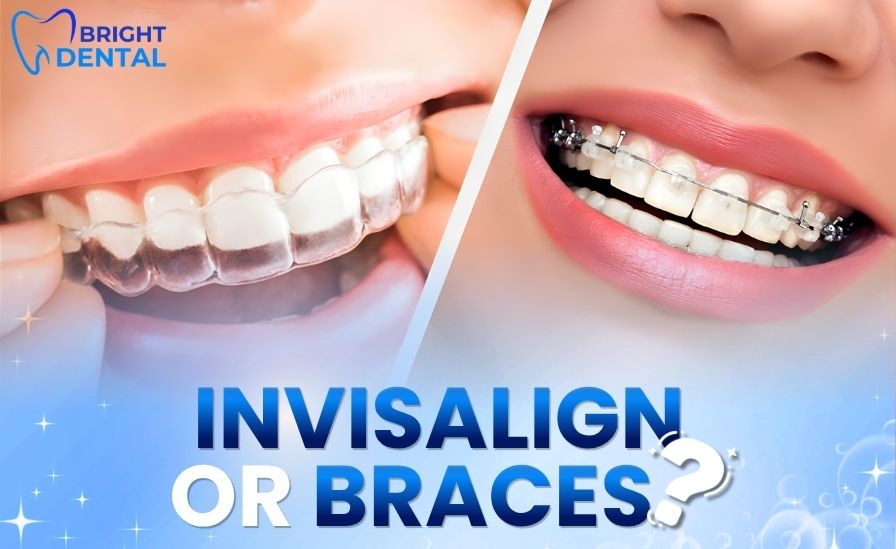
Here is a straightforward breakdown of how the two options differ for adult patients specifically:
Invisalign for Adults
Invisalign is the most popular choice among our adult patients, and it’s easy to understand why. The aligners are virtually invisible, removable for meals and important social or professional occasions, and require no dietary restrictions. You eat whatever you want, brush and floss normally, and attend fewer office visits than traditional braces typically require.
At Bright Dental, we use the Medit i900 intraoral scanner to create a precise 3D digital map of your teeth before your Invisalign aligners are manufactured. This technology eliminates the uncomfortable impression trays of the past and allows us to show you a digital simulation of your expected results before treatment even begins. You can see where your teeth are going before a single aligner is placed.
Invisalign works exceptionally well for mild to moderate crowding, spacing issues, and many bite corrections. For genuinely complex cases, we discuss this transparently during your consultation and recommend the option most likely to give you the outcome you are looking for.
Traditional Braces for Adults
Metal braces remain the most clinically precise orthodontic tool available for complex cases. If you have significant bite issues — a pronounced overbite, underbite, crossbite, or severe crowding — traditional braces may produce more predictable results, particularly for movements that require precise three-dimensional control.
Modern braces are considerably smaller and more comfortable than what many adults remember from childhood. They are fixed to your teeth and work continuously, which removes the compliance factor entirely — your treatment progresses whether or not you remember to do anything.
For adults whose priority is clinical outcome over aesthetics, or whose cases genuinely require the precision only fixed appliances can provide, traditional braces remain an excellent choice.
💡 Related Read: Want a detailed side-by-side breakdown of both options? Read our complete guide on Invisalign vs. Traditional Braces in Des Plaines for everything you need to know before deciding.
What Adult Orthodontic Treatment Actually Looks Like Day to Day
One of the biggest hesitations adult patients have is practical — how does this actually fit into a real adult life with a job, family, and social commitments?
With Invisalign
Your daily routine changes very little. You wear your aligners for 20 to 22 hours per day, removing them only to eat, drink anything other than water, and to brush and floss. Most people you interact with daily — coworkers, clients, friends — will not notice you are wearing them unless they are looking closely.
You swap to a new set of aligners every one to two weeks at home. Office visits at Bright Dental are required only every six to eight weeks for progress checks, meaning the treatment integrates easily into a busy schedule.
The most important discipline Invisalign requires is consistency. Wearing your aligners for fewer than 20 hours per day slows treatment and can affect results. Patients who are diligent about wear time consistently achieve their outcomes on schedule.
With Traditional Braces
Life with braces as an adult is more of an adjustment, but it is entirely manageable. You avoid certain foods — anything hard, sticky, or crunchy that could damage brackets or wires — and you add a few steps to your oral hygiene routine to clean around the hardware effectively.
💡 Related Read: Our detailed guide on Living with Braces and Invisalign in Des Plaines covers day-to-day care tips, foods to avoid, and how to handle common issues like a loose bracket or poking wire.
Office visits for braces adjustments occur every four to six weeks. Each appointment is typically short — 20 to 30 minutes — and our team works around your schedule.
How Long Does Adult Orthodontic Treatment Take?
Treatment timelines for adults vary based on the complexity of tooth movement required, not on age itself. A straightforward spacing case might be resolved in as few as six to nine months with clear aligners. Moderate crowding typically takes twelve to eighteen months. More complex cases involving significant bite correction may take two years or longer.
During your free consultation at Bright Dental, we give you a realistic, personalized timeline estimate based on your specific case — not a generic answer. We use your digital scan to map the movements required and discuss the timeline honestly, including what factors could affect it.
What Happens After Treatment — Retainers for Adults
This is a section many patients overlook when researching orthodontics, and it is genuinely important — perhaps more so for adults than for younger patients.
Once your braces come off or your final Invisalign aligner is completed, your teeth have been moved into new positions. Without retention, they will gradually shift back toward their original positions. This is not a flaw in the treatment — it is simply how teeth behave. The periodontal ligament has a natural memory and will pull teeth back over time without a retainer holding them in place.
For adults, this tendency can actually be slightly stronger than in younger patients because the denser bone surrounding the teeth exerts more force as it remodels around the new positions.
At Bright Dental, we provide a personalized retention plan at the end of every orthodontic case. Most adult patients use a combination of a fixed retainer — a thin wire bonded to the back of the front teeth — and a removable nighttime retainer worn while sleeping.
💡 Related Read: Learn exactly why retention matters and what your options are in our full guide on Retainers After Braces in Des Plaines.
The Health Benefits of Straight Teeth That Have Nothing to Do with Appearance
Adult patients often come in motivated by aesthetics but leave with a much broader appreciation of why straight teeth matter for their overall health.
Easier cleaning: Crowded or overlapping teeth create spaces that are genuinely difficult to clean with a toothbrush or floss. Food and plaque accumulate in these areas and contribute directly to cavity formation and gum disease over time. Straight teeth are easier to clean thoroughly — which means less decay and healthier gums for life.
Reduced jaw strain: Misaligned bites place uneven pressure on the jaw joints and chewing muscles. Over years, this can contribute to TMJ pain, jaw clicking, and chronic headaches. Correcting your bite reduces this strain and can relieve symptoms many adult patients have lived with for years without connecting them to their teeth.
Better sleep: Certain bite patterns and tooth positions contribute to airway narrowing during sleep. In some patients, orthodontic correction as part of a broader treatment plan can reduce snoring and sleep-related breathing issues.
Improved confidence: This one is harder to quantify but impossible to ignore. Patient after patient at Bright Dental tells us that completing orthodontic treatment changed not just how they look but how they carry themselves — how freely they laugh, how confidently they speak in meetings, how comfortable they feel in photographs.
How Much Does Adult Orthodontic Treatment Cost in Des Plaines?
Orthodontic treatment is a meaningful investment, and we believe in complete transparency about costs before you commit to anything.
Treatment costs at Bright Dental vary based on the complexity of your case and the type of treatment — traditional braces or clear aligners. During your free consultation, we provide a detailed, personalized quote that includes everything involved in your treatment from start through retention.
We work with most major dental insurance providers, including Aetna, BlueCross BlueShield, and Cigna, and many plans include partial orthodontic coverage for adult patients. We also offer flexible payment options to help spread the investment over your treatment period.
The most important thing to know is that you will never receive a surprise bill at Bright Dental. Everything is discussed and agreed upon before treatment begins.
Why Des Plaines Adults Choose Bright Dental for Orthodontics
Patients across Des Plaines, Park Ridge, Rosemont, Mount Prospect, Niles, and Elk Grove Village choose Bright Dental for adult orthodontics for reasons that go beyond the treatments themselves.
25 years of local experience: Dr. Furrukh Ashraf has been treating the Des Plaines community for over two decades. When you start orthodontic treatment at Bright Dental, the doctor who plans your case is the same doctor who monitors it from start to finish — not a rotating roster of providers.
Digital precision: Our Medit i900 scanner produces exact 3D models of your teeth, eliminating guesswork and giving you a visual preview of your treatment before it begins. This is the same technology used by the most advanced dental practices in the country, available right here in Des Plaines.
Honest consultations: If Invisalign is not the right tool for your case, we will tell you — and explain exactly why. Our reputation is built on trust, not on selling the most expensive option.
Flexible scheduling: We know adult patients have jobs, families, and commitments. We work around your schedule, not the other way around.
Comprehensive care under one roof: If your orthodontic evaluation reveals underlying issues — gum concerns, sensitivity, or other dental needs — we address everything in one place. You don’t need referrals to multiple practices.
Se habla español: Our team proudly serves the full Des Plaines community, including our Spanish-speaking patients and families.
Frequently Asked Questions — Adult Orthodontics in Des Plaines
Am I too old for orthodontic treatment? No. There is no upper age limit for orthodontic treatment as long as your teeth and gums are healthy. We have treated patients in their 60s successfully. Age affects treatment speed slightly but not the final result.
Will braces or Invisalign affect my speech? There is a brief adjustment period with both options — typically one to two weeks — during which your speech may be very slightly affected as your mouth adapts. This resolves on its own for the vast majority of patients.
Can I get orthodontic treatment if I have dental implants or crowns? Yes, in most cases. Implants themselves cannot be moved by orthodontic force since they are anchored directly in the bone — but natural teeth surrounding an implant can be positioned to accommodate it. Crowns and veneers do not affect tooth movement. We assess all existing restorations during your consultation.
What if I had braces as a kid and my teeth have shifted back? This is extremely common and entirely treatable. Many adults come to us with exactly this situation — previous orthodontic treatment without consistent retainer use, resulting in relapse. A new course of treatment, followed by a proper long-term retention plan, produces lasting results this time.
Does orthodontic treatment hurt? There is typically mild soreness for two to three days after each adjustment or aligner change — a sign that your teeth are moving. Over-the-counter pain relief manages this easily. It is not the intense discomfort many adults remember or fear from childhood.
Take the First Step — Book Your Free Adult Orthodontic Consultation in Des Plaines
If you’ve been putting this off — telling yourself it’s too late, too inconvenient, or just not for someone your age — this is your reminder that none of those things are true. Thousands of adults across Des Plaines and the surrounding communities are in the middle of orthodontic treatment right now, and most of them wish they had started sooner.
Your consultation at Bright Dental is completely free, carries no obligation, and gives you a clear, honest picture of what treatment would involve for your specific case — timeline, cost, treatment type, and expected results.
Serving Des Plaines, Park Ridge, Rosemont, Mount Prospect, Niles, and Elk Grove Village. Se habla español.

