
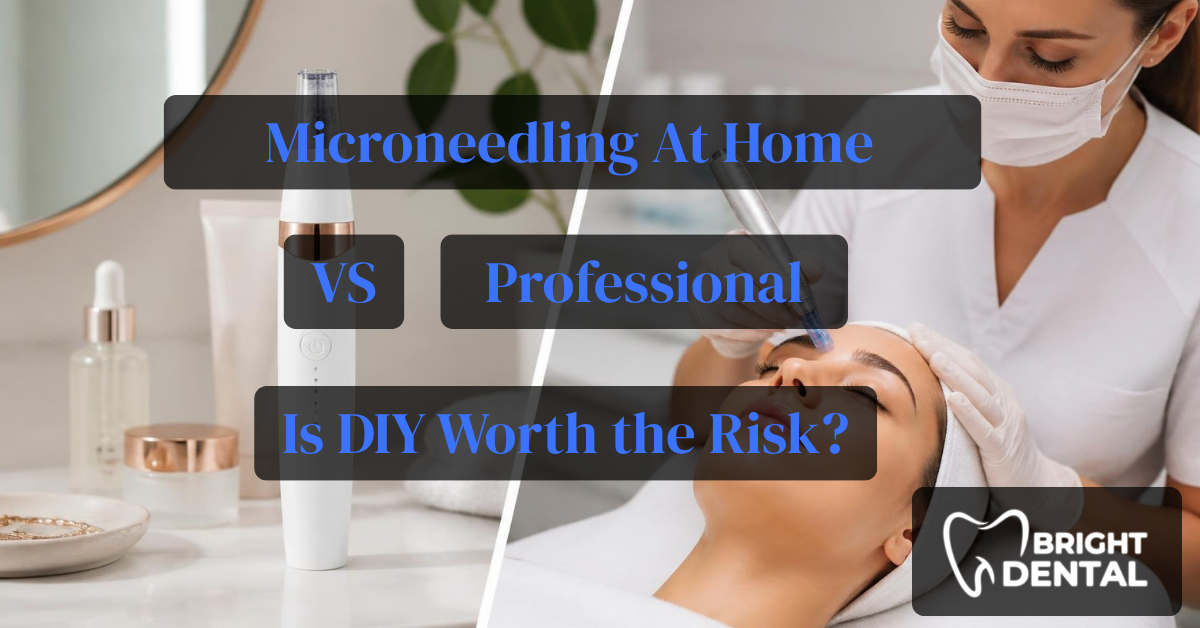

Scroll through any beauty aisle or social media feed and you’ll find no shortage of derma rollers and at-home microneedling devices promising professional-level skin results for a fraction of the cost. It’s an appealing pitch — but is it accurate? When it comes to microneedling at home vs professional treatment, the differences go far beyond price. Needle depth, sterility, technique, and safety all play a major role in both the results you’ll see and the risks you might be taking on. In this guide, we’ll break down how at-home devices really compare to professional microneedling, and help you answer the question a lot of people are quietly asking: is at-home microneedling safe?
What Is Microneedling, and Why Does the Setting Matter?
Microneedling works by creating controlled micro-injuries in the skin using fine needles, which triggers the body’s natural wound-healing response and stimulates collagen and elastin production. This process is what leads to improvements in skin texture, firmness, and the appearance of fine lines and scarring over time.
The key phrase here is “controlled.” The depth, consistency, and sterility of those micro-injuries determine both how effective the treatment is and how safe it is — and this is exactly where at-home and professional treatments diverge.
Derma Roller vs Professional Microneedling: The Core Differences
1. Needle Depth
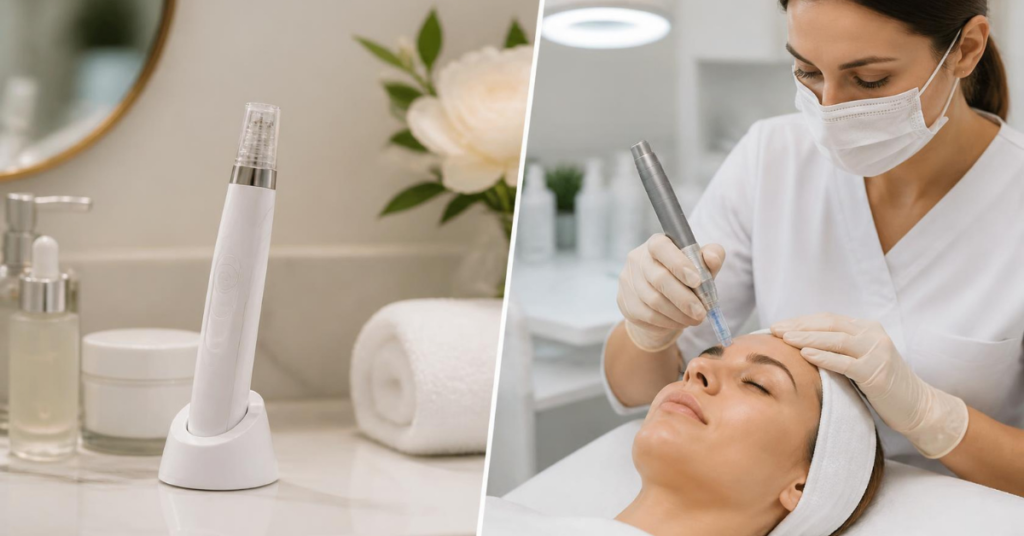
This is one of the most significant differences in the derma roller vs professional microneedling comparison. At-home derma rollers typically use needles ranging from about 0.25mm to 0.5mm in length, intended for surface-level use. Professional microneedling devices, often using motorized pens rather than rollers, can safely reach depths of 1.5mm to 2.5mm or more, depending on the treatment area and goals. Deeper, controlled penetration is necessary to meaningfully stimulate collagen production in the deeper dermal layers — something shallow, at-home devices simply aren’t designed or safe to do.
2. Precision and Technique
Professional microneedling pens use a consistent, vertical stamping motion with adjustable depth settings, allowing for even, controlled treatment across different areas of the face. Derma rollers, by contrast, are rolled across the skin at an angle, which can create uneven pressure and inconsistent puncture depth — increasing the risk of micro-tearing, especially around delicate areas like under the eyes.
3. Sterility and Infection Control
In a professional setting, single-use, medical-grade needles and a controlled clinical environment significantly reduce the risk of infection. At-home devices are reused repeatedly, and even with proper cleaning, they’re far more difficult to fully sterilize between uses, particularly around the tiny grooves where needles meet the roller barrel.
4. Professional Oversight
A trained provider can assess your skin, adjust needle depth based on treatment area, and identify any contraindications (like active acne, certain skin conditions, or medications that increase bleeding risk) before treatment begins — an evaluation that’s simply not possible with an at-home device.
5. Complementary Treatments
Professional microneedling sessions often incorporate serums or treatments designed to work synergistically with the deeper channels created during the procedure, enhancing absorption and results in ways at-home products generally can’t replicate at a surface level.
Is At-Home Microneedling Safe?
The honest answer: it depends heavily on the device, technique, and consistency of use — but there are real risks worth understanding before trying it yourself.
Potential Risks of At-Home Microneedling
- Infection — Reused needles that aren’t properly sterilized can introduce bacteria into the skin, particularly with lower-quality or damaged rollers.
- Uneven results or skin damage — Inconsistent pressure and angle can lead to micro-tearing, irritation, or even scarring if used incorrectly.
- Overuse — Without professional guidance, it’s easy to use a derma roller too frequently, which can actually damage the skin barrier rather than improve it.
- Ineffective results — Because at-home devices generally can’t reach therapeutic depths, many users see minimal improvement despite consistent use, leading to frustration or, worse, overcompensating by pressing harder or rolling more aggressively — which increases risk without improving results.
- Product contamination — Applying serums or products immediately after at-home microneedling, when the skin’s protective barrier is temporarily compromised, can introduce irritants or bacteria if those products aren’t formulated for use on freshly treated skin.
When At-Home Use Might Be Reasonably Safe
Lower-depth derma rollers (around 0.25mm) used infrequently, with proper cleaning and gentle technique, are generally considered lower-risk for surface-level texture maintenance. However, even at this level, they’re not a substitute for professional treatment when it comes to meaningfully addressing collagen decline, acne scarring, or more visible signs of aging — you can learn more about what a professional treatment actually addresses in our guide on what to expect at your first professional microneedling appointment.
Curious What Professional Microneedling Could Do for Your Skin?
If you’ve been relying on an at-home device without seeing the results you’re hoping for — or you’re wary of the risks — a professional consultation can show you what’s actually possible with clinical-grade treatment.
Results: What’s the Realistic Difference?
When comparing microneedling at home vs professional treatment in terms of actual outcomes:
- At-home devices may offer very mild improvements in surface texture and product absorption over time, but they’re unlikely to meaningfully address deeper concerns like acne scarring, significant fine lines, or noticeable collagen loss.
- Professional treatment is capable of reaching therapeutic depths that trigger a more substantial collagen-building response, making it far more effective for addressing visible signs of aging, texture irregularities, and scarring.
This gap in results is one of the main reasons dermatologists and licensed providers generally recommend professional microneedling for anyone seeking real, measurable improvement, reserving at-home rollers for light maintenance between sessions at most.
Why More Patients Are Choosing Professional Providers Over DIY
Interest in non-surgical cosmetic treatments has grown significantly in recent years, partly fueled by social media exposure to both professional results and at-home alternatives. As awareness has grown, so has understanding of the real difference between the two — which is part of why more patients are opting for professional treatment. Curious how this shift has played out more broadly? We cover it in our piece on why more people are choosing non-surgical cosmetic treatments. Choosing a provider with a strong understanding of facial anatomy also matters significantly for both safety and results — something we explore further in our guide on why patients are choosing dental professionals for facial aesthetic treatments.
Cost Considerations: Is DIY Really Cheaper?
At-home devices have a clear upfront cost advantage — a basic derma roller costs a fraction of a single professional session. However, this comparison isn’t quite as simple as it looks:
- At-home results, when they occur at all, tend to be modest and require frequent, ongoing use to maintain even minor improvements.
- Risk of complications (infection, skin damage) can lead to costs far exceeding the original savings if professional treatment is needed to address the damage.
- Professional treatments often produce longer-lasting, more significant results per session, which can make the actual cost-per-result more comparable than the sticker price suggests.
How to Decide Between At-Home and Professional Microneedling
- If you’re addressing acne scarring, visible aging, or significant texture concerns: Professional treatment is strongly recommended, since at-home devices generally can’t reach the depth needed for meaningful improvement.
- If you’re looking for light surface maintenance between professional sessions: A gentle, low-depth derma roller used infrequently and with proper hygiene may be reasonable, though it’s still worth checking with your provider first.
- If you’re unsure about safety, technique, or product compatibility: A professional consultation is the safest way to get a clear answer specific to your skin.
The Bottom Line
When it comes to microneedling at home vs professional treatment, the difference isn’t just about convenience or cost — it’s about depth, precision, sterility, and safety. In the derma roller vs professional microneedling comparison, at-home devices are simply not built to reach the depths needed for significant collagen stimulation, and they carry real risks around infection and inconsistent technique. So, is at-home microneedling safe? In limited, low-depth, well-maintained use, it carries relatively low risk for surface maintenance — but it’s not a safe or effective substitute for professional treatment when it comes to addressing real skin concerns.
Our team at Bright Dental in Des Plaines combines dental-level precision with facial aesthetics expertise to deliver safe, effective microneedling results. Explore our microneedling services or reach out to schedule a consultation.

