
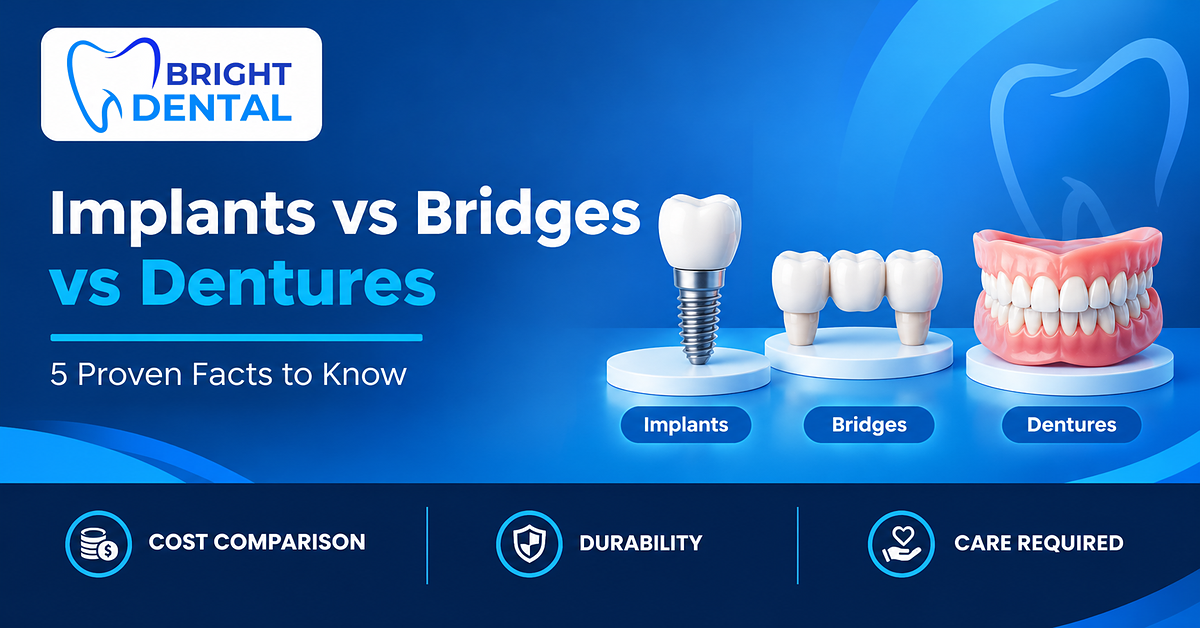

Missing one or more teeth leaves you with three main replacement options, and choosing between implants vs bridges vs dentures can feel overwhelming. Weighing implants vs bridges vs dentures means looking closely at cost, durability, and care routine for each. In this guide from Bright Dental, you will learn how these three options compare, so you can make an informed decision with your dentist.
Quick answer: Implants vs bridges vs dentures comes down to a tradeoff between upfront cost, long-term durability, and how much of your natural teeth are affected. Implants tend to last longest, bridges sit in the middle, and dentures are the most affordable upfront but need the most maintenance.
What Are Dental Implants vs Bridges vs Dentures?
Dental Implants
A titanium post is placed in the jawbone to act as an artificial tooth root, with a crown, bridge, or denture attached on top. This is the only option that replaces the tooth root itself.
Dental Bridges
A bridge fills a gap using a false tooth anchored to the natural teeth on either side, which are shaped down to support crowns.
Dentures
A removable appliance that replaces some or all of the teeth in an arch, held in place by suction, adhesive, or clasps onto remaining teeth.
5 Key Facts to Help You Compare Implants vs Bridges vs Dentures
- Implants Protect the Jawbone, Bridges and Dentures Do Not — only implants stimulate the jawbone the way a natural tooth root does. Bridges and dentures sit on top of the gum and bone, so bone loss can continue underneath them over time.
- Bridges Require Altering Healthy Teeth — a traditional bridge needs the neighboring teeth ground down to support it. Implants and dentures do not require this.
- Implants May Last the Longest — with proper care, dental implants can last for decades. Dental bridges typically last around 10–15 years, while dentures may need relining or replacement every 5–8 years. Actual lifespan varies depending on oral hygiene and maintenance.
- Dentures Are the Most Affordable Upfront — bridges sit in the middle, and implants typically have the highest upfront investment, though implants often cost less over a decade when you factor in replacements.
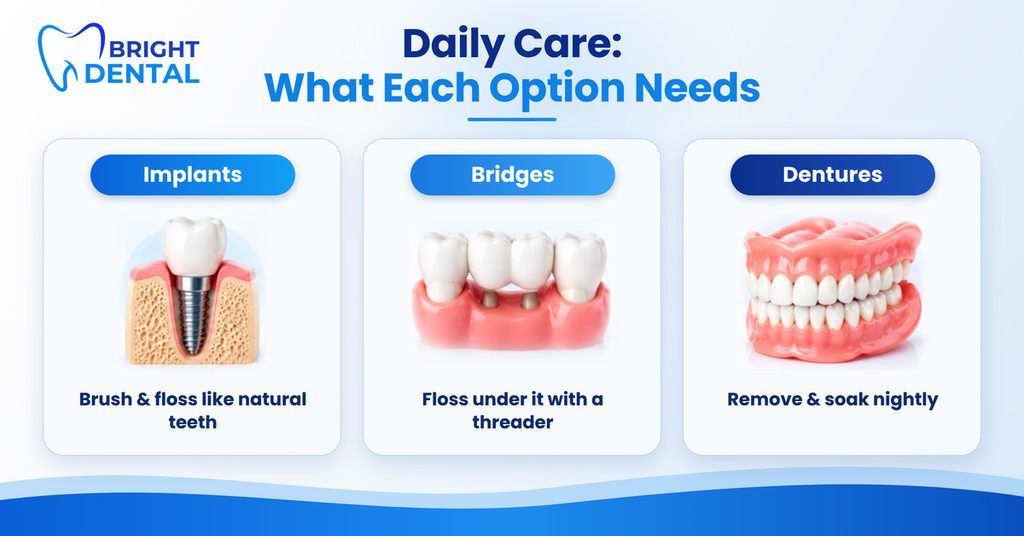
- Daily Care Differs Significantly — implants and bridges are cared for like natural teeth. Dentures must be removed nightly for cleaning and soaking, and they require denture adhesive for many wearers.
Side-by-Side Comparison of Implants vs. Bridges vs. Dentures
| Feature | Dental Implants | Dental Bridges | Dentures |
|---|---|---|---|
| Affects neighboring teeth | Usually no | Yes, traditional bridges require reshaping supporting teeth | Usually no |
| Bone preservation | Can help preserve bone around implant sites | Does not replace the tooth root | Does not replace the tooth root |
| Typical lifespan | Can last decades with proper care | Often around 10–15 years | May need relining or replacement every 5–8 years |
| Daily care | Brush and clean between teeth as instructed | Brush and clean under the bridge | Remove and clean daily as instructed |
| Upfront cost | Generally highest | Generally moderate | Generally lowest |
| Stability | Fixed restoration | Fixed restoration | May shift, depending on fit and type |
Note: Lifespans and costs are approximate and vary by patient, materials, maintenance, and treatment needs. These estimates are not guarantees.
For more information about replacing missing teeth, read the American Dental Association’s guide to missing teeth, which explains common tooth replacement options.
Which Option Fits Which Situation?
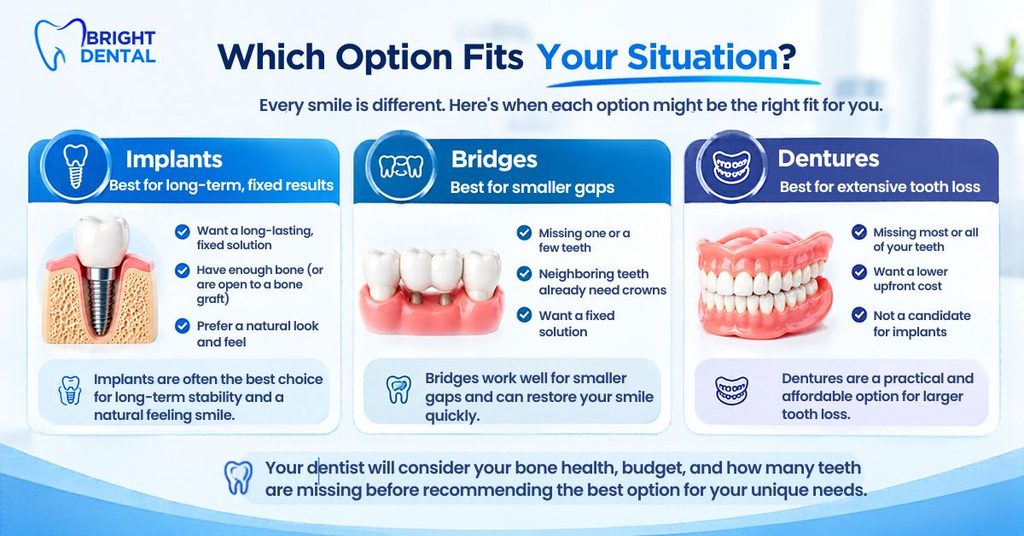
Implants are often the best fit when you want a long-term, fixed solution and have enough bone, or are open to a bone graft. For patients missing most of their teeth, All-on-4 dental implants may be another treatment option to discuss with a dentist. Bridges can work well when you are missing one or a few teeth and the neighboring teeth already need crowns. Dentures are often chosen when a patient is missing most or all of their teeth and prefers a lower upfront cost or is not a candidate for implants.
Your dentist will consider your bone health, budget, and how many teeth are missing before recommending the best option. Comparing implants vs bridges vs dentures with your dentist can help you choose a treatment that fits your oral health needs and long-term goals.
Can You Combine These Options?
Many patients use a combination approach. Implant-supported dentures, for example, use a small number of implants to anchor a denture firmly in place, combining the stability of implants with the lower cost of a denture-based solution. This bridges some of the gap when weighing implants vs bridges vs dentures as standalone options.
Frequently Asked Questions
Which option is cheapest in the long run?
While dentures have the lowest upfront cost, they often need relining or replacement every several years, which can add up. Implants have a higher initial cost but often prove more economical over a decade or more.
Can I switch from dentures to implants later?
Many patients who start with dentures later transition to implants, assuming they have enough bone or are willing to have a bone graft first.
Do bridges damage healthy teeth?
The teeth supporting a bridge are permanently shaped down to hold the crowns, which is a tradeoff to keep in mind compared to implants.
Which option looks the most natural?
Implants generally look and feel the most like natural teeth, since the crown is anchored independently rather than resting on the gum or attaching to nearby teeth.
Looking to Compare Implants vs Bridges vs Dentures Near Deer Park, Libertyville, or Highland Park?
Bright Dental proudly serves patients from Des Plaines, Mount Prospect, Deer Park, Libertyville, and Highland Park. Our team can walk you through which option best fits your bone health, budget, and smile goals.
Conclusion
There is no single best answer when weighing implants vs bridges vs dentures, since the right choice depends on your bone health, budget, and how many teeth you are replacing. Implants offer the longest-lasting, most natural-feeling result, bridges work well for smaller gaps, and dentures remain a practical option for extensive tooth loss.
